
Read this as a readiness set, not a national ranking
CMS Form 2786R is the controlling public map for healthcare Life Safety Code survey tags, but the cited CMS materials do not publish a current nationwide frequency table that supports a definitive one-through-ten ranking. The ten topics below are a practical high-frequency readiness set drawn from recurring physical-environment failure modes. Use the current form, adopted code, provider type, and actual facility conditions to determine applicability; never turn a shorthand list into a substitute for the complete requirement.123
K211 and K222: means of egress and egress doors
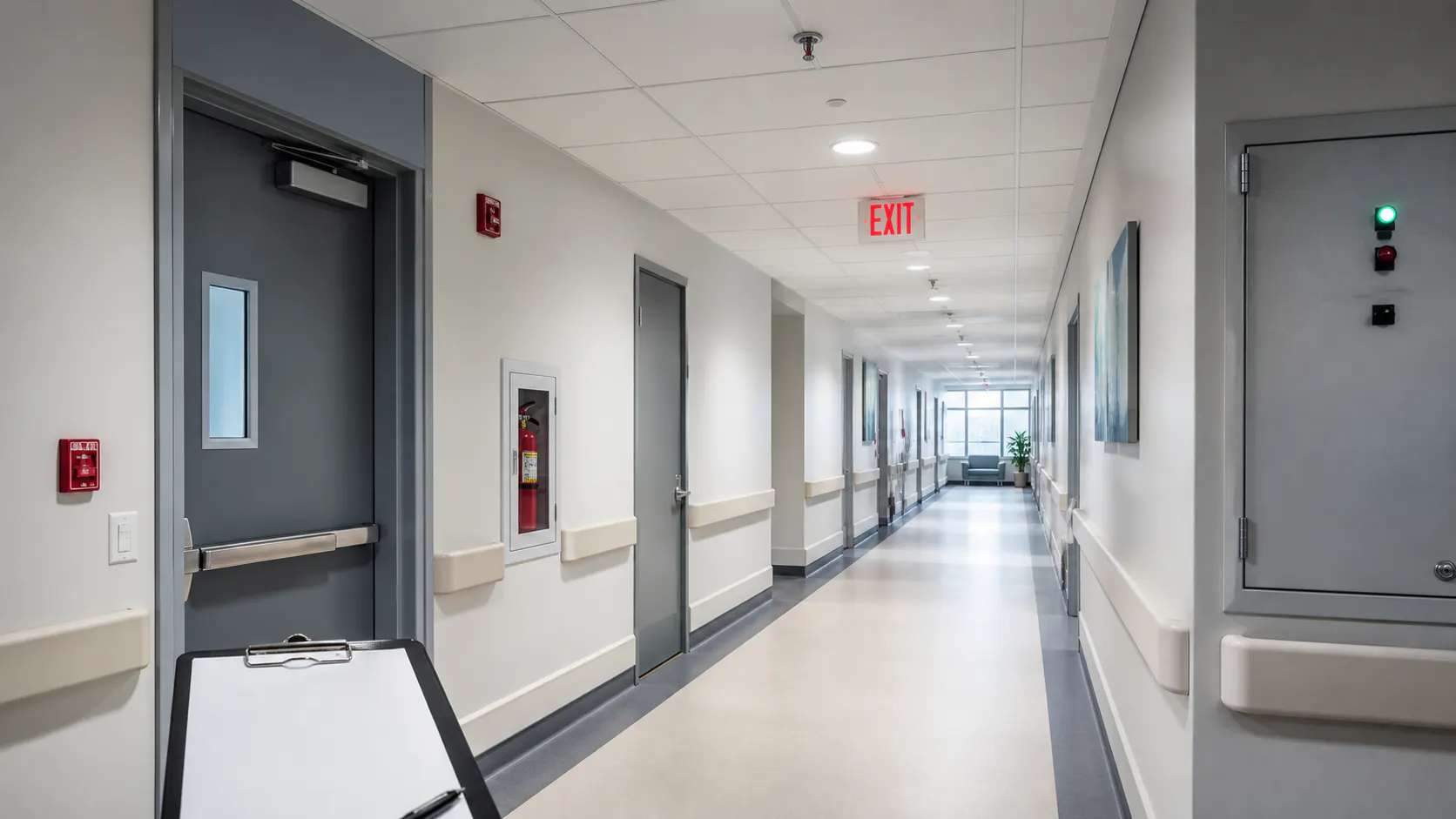
K211 addresses the general means-of-egress condition and is also the tag CMS identified for annual fire-door assembly inspection deficiencies in its fire-door memorandum. K222 focuses on egress-door arrangements. Avoid findings by controlling the door inventory, testing applicable fire doors on the required cycle, correcting closing and latching problems, and routinely walking egress routes for blocked, disguised, or improperly secured doors. Verify hardware and special arrangements against approved design information rather than relying on a door label or staff recollection.1586
K223 and K271: locking and exit discharge
K223 brings attention to door-locking arrangements, where clinical needs, delayed egress, sensor release, controlled access, and ordinary security hardware can be confused. K271 follows the route through exit discharge to a safe exterior condition. Review each locking system as a complete sequence, including release inputs, power loss, staff procedures, and approved application. Walk discharge routes in realistic conditions and verify illumination, weather exposure, gates, changes in level, construction impacts, and access to the public way.1611
K321 and K363: hazardous areas and corridor doors
K321 concerns hazardous-area protection; K363 concerns corridor doors. Common breakdowns include rooms whose contents outgrow their classification, incomplete enclosures, unprotected penetrations, missing self-closing features where required, doors that do not resist smoke passage as intended, and field-installed hardware that defeats operation. Maintain a room-use inventory, compare current contents with the approved protection strategy, and sample the complete boundary. For corridor doors, inspect the leaf, frame, clearances, latching, glazing, and unauthorized openings as one functional assembly.169
K341 and K353: fire alarm and sprinkler reliability
K341 addresses the fire alarm system and K353 addresses sprinkler-system maintenance. Survey exposure often begins with incomplete testing records, impaired components, supervisory signals that were not resolved, missing devices after renovation, painted or obstructed sprinklers, or discrepancies between drawings, inventories, and field conditions. Build testing from a controlled device population, reconcile failures to work orders, document impairments and notifications, and independently verify restoration. A clean inspection certificate does not resolve excluded devices or deficiencies listed elsewhere in the report.16910
K372 and K918: smoke barriers and emergency power
K372 focuses on smoke-barrier construction; K918 addresses electrical systems and emergency generator testing. Above-ceiling penetrations, undocumented joints, damaged assemblies, and project-created openings can undermine a smoke barrier. Generator records may fail to demonstrate the required sequence, load, duration, transfer behavior, or corrective follow-through. Control barrier work with permits and verified closeout. For emergency power, map each required test element to the applicable NFPA 99 and referenced electrical standard pathway, then retain complete results and resolve exceptions.16711
Prevent recurrence with an extent-of-condition review
The most defensible prevention method is not a last-minute checklist; it is a repeatable loop. Define the requirement, verify the asset population, sample field performance, trace exceptions into corrective action, assess the extent of condition, and monitor recurrence. Trend repeat findings by building, contractor, system, and failure type. During mock surveys, ask escorts to retrieve the governing record and explain open items honestly. This turns the ten topics into management signals and helps the facility find systemic weaknesses before a surveyor does.24910
Explore the complete topic
Continue from this article into the connected cornerstone guides, detailed conditions, exact questions, and related services.