
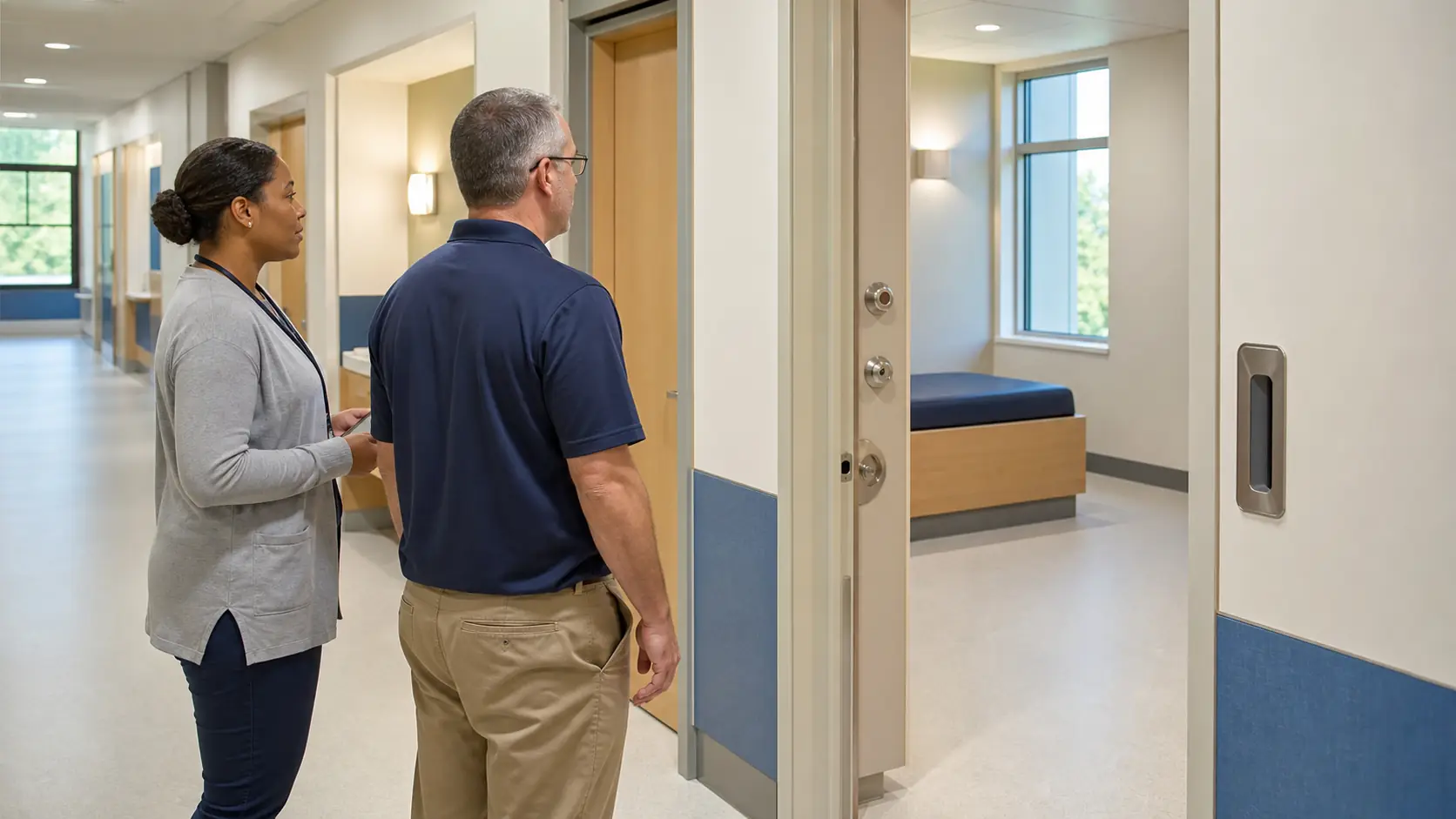
Treat both risks as patient-safety requirements
Ligature-resistance work and Life Safety requirements protect patients from different hazards; one should not be used as an informal reason to defeat the other. Establish a multidisciplinary team that includes behavioral health, nursing, psychiatry, facilities, life safety, security, infection prevention, design professionals, and leadership. Define the patient population, level of observation, unit boundaries, occupancy, adopted requirements, accreditation expectations, and approved risk-assessment method. Document conflicts explicitly and route them for qualified interpretation before purchasing hardware or changing doors, alarms, ceilings, sprinklers, or staff procedures.123456789
Assess the complete care environment
Evaluate patient rooms, bathrooms, corridors, activity spaces, interview rooms, seclusion areas, doors, hardware, glazing, furnishings, plumbing, ceilings, equipment, and staff-controlled support areas according to actual patient access and supervision. At the same time, review means of egress, door operation, locking arrangements, fire alarm notification, sprinkler protection, smoke compartment movement, emergency access, and defend-in-place procedures. Avoid universal conclusions based on one product or room type. Risk changes with patient population, staffing model, visibility, observation level, maintenance condition, and how spaces are used across shifts.123456789
Control door and locking decisions
A ligature-resistant device is not automatically compatible with a rated door assembly, required latching, releasing operation, accessibility, emergency access, or an approved clinical-needs locking arrangement. Review the complete door, frame, hardware, power, alarm interface, staff control, and emergency sequence before modification. Preserve listings and required field approvals. Test the installed arrangement under controlled conditions with clinical and security participation. Document who can release the door, how failures are recognized, what happens on loss of power or alarm, and how staff maintain observation during an emergency.123456789
Manage fire protection and notification features
Changes intended to reduce anchor points can affect sprinkler coverage, detector access, alarm appliances, ceiling integrity, and maintenance access. Select products and protective approaches through coordinated clinical, engineering, infection-control, and code review. Staff must be able to recognize and respond to alarms even when patient notification methods, security boundaries, or observation procedures differ from general hospital areas. Establish a safe maintenance process for inspecting concealed or protected components without leaving tools, access panels, or temporary conditions that introduce a new patient hazard.123456789
Document individualized controls and change management
Record the environmental risk assessment, approved design decisions, patient-access assumptions, staff controls, inspection frequencies, maintenance responsibilities, and emergency procedures. Train staff on the actual unit arrangement rather than a generic behavioral-health policy. Reassess after incidents, near misses, room conversions, hardware replacement, patient-population changes, construction, or changes in observation practice. Temporary repairs require the same interdisciplinary scrutiny as permanent work because tape, cords, barricades, removed hardware, or propped doors can create both ligature and Life Safety hazards.123456789
Build evidence that follows the work
A defensible record connects the requirement or facility policy to a stable location, asset, responsible department, completion date, result, deficiency, immediate protection, corrective action, and verified closure. Keep source documents, inspection forms, work orders, photographs where appropriate, vendor reports, and leadership decisions under document control. A signature or invoice proves that an activity occurred, but it does not by itself prove that the correct population was reviewed, the acceptance criteria were met, or every exception was resolved. Sample records against actual field conditions and preserve unresolved limitations as open work rather than allowing them to disappear during report closeout.123456789
Sustain readiness through leadership review
Trend overdue activities, repeat findings, unavailable assets, failed tests, deferred areas, contractor performance, and time from discovery to verified closure. Report material risk and recurring process weaknesses to the Environment of Care committee or other authorized leadership forum with an owner and due date. Reassess the program after construction, equipment replacement, utility changes, incidents, regulatory updates, or accreditation findings. The goal is continuous compliance: staff should be able to retrieve the current record, explain the management process, demonstrate the condition in the field, and show how leaders use results to reduce risk rather than assembling disconnected documents immediately before a survey.123456789
Explore the complete topic
Continue from this article into the connected cornerstone guides, detailed conditions, exact questions, and related services.