
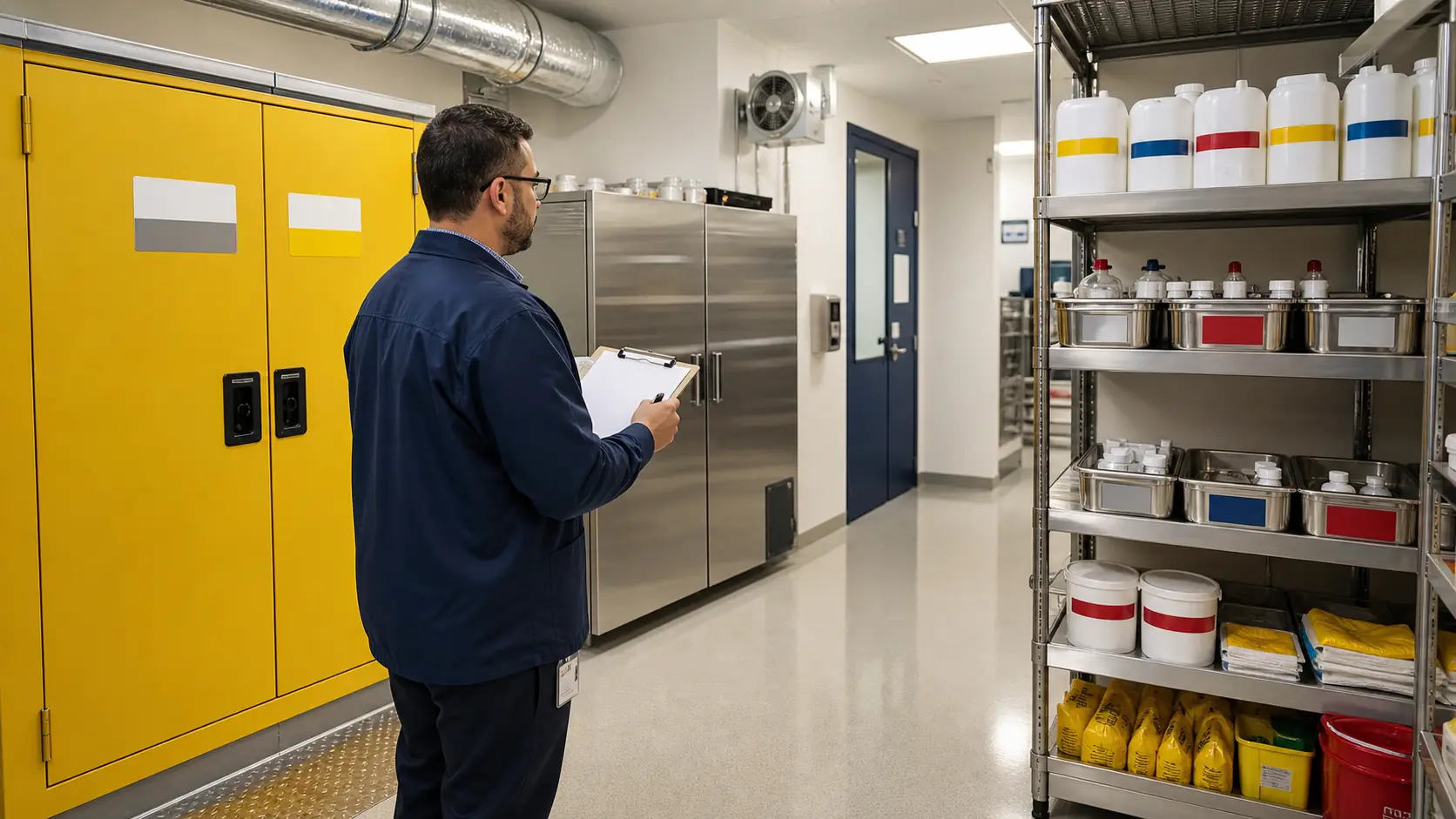
Build a location-based inventory
Identify hazardous chemicals, pharmaceuticals, compressed gases, flammable and combustible materials, cleaning products, laboratory supplies, waste streams, maintenance products, and contractor materials by actual storage and use location. Connect the inventory to safety data, responsible department, maximum expected quantity, hazard class, container type, and emergency contact. Include loading areas, satellite accumulation points, carts, closets, laboratories, pharmacies, shops, construction zones, and temporary staging. Reconcile purchasing and waste records with field observations because unrecorded products and abandoned containers can defeat an otherwise complete central inventory.123456789
Determine storage and room requirements
Evaluate each location using the material hazards, quantities, adopted codes, federal and local rules, accreditation expectations, manufacturer instructions, and approved facility policy. Observe cabinets, shelving, segregation, secondary containment, ventilation, temperature, ignition control, access, security, signs, spill supplies, grounding or bonding where applicable, and protection from impact. Coordinate with Life Safety drawings and hazardous-area classifications when storage affects enclosure or protection requirements. Avoid declaring a room compliant from a cabinet label alone; the contents, quantities, construction, door, ventilation, and operational practices must be understood together.123456789
Inspect day-to-day handling practices
Observe receiving, transport, dispensing, decanting, use, return, waste collection, and after-hours storage. Check container condition, compatible closures, readable identification, expiration or stability concerns, aisle and egress clearance, access to fire protection, and separation from patient or public areas. Interview staff about spills, exposures, damaged containers, unknown substances, and prohibited storage. Contractor materials require the same facility control as hospital-owned supplies. Correct immediate hazards safely and avoid moving, opening, or combining unknown materials without qualified hazardous-material guidance.123456789
Coordinate emergency response and impairments
Emergency procedures should address discovery, isolation, notification, evacuation or defend-in-place considerations, spill response, fire department information, exposure evaluation, cleanup, waste disposal, and return to service. Verify that staff can retrieve current safety information and know when not to intervene. Consider how a spill or storage problem may impair egress, ventilation, fire protection, utilities, or patient care. During construction or department moves, define temporary storage limits, daily inspection, emergency access, and closeout responsibilities so short-term staging does not become an uncontrolled permanent condition.123456789
Manage findings across departments
Assign each condition to the department that controls the material and the department that controls the room or building feature. A leaking container may require immediate material response, while damaged ventilation, an inappropriate cabinet, or an enclosure problem needs facilities or capital action. Document the extent review for similar locations and products. Trend recurring issues by department, supplier, product, storage type, and cause. Use committee reporting to resolve procurement, space, training, pickup-frequency, or project-design problems that cannot be corrected through a one-time housekeeping request.123456789
Build evidence that follows the work
A defensible record connects the requirement or facility policy to a stable location, asset, responsible department, completion date, result, deficiency, immediate protection, corrective action, and verified closure. Keep source documents, inspection forms, work orders, photographs where appropriate, vendor reports, and leadership decisions under document control. A signature or invoice proves that an activity occurred, but it does not by itself prove that the correct population was reviewed, the acceptance criteria were met, or every exception was resolved. Sample records against actual field conditions and preserve unresolved limitations as open work rather than allowing them to disappear during report closeout.123456789
Sustain readiness through leadership review
Trend overdue activities, repeat findings, unavailable assets, failed tests, deferred areas, contractor performance, and time from discovery to verified closure. Report material risk and recurring process weaknesses to the Environment of Care committee or other authorized leadership forum with an owner and due date. Reassess the program after construction, equipment replacement, utility changes, incidents, regulatory updates, or accreditation findings. The goal is continuous compliance: staff should be able to retrieve the current record, explain the management process, demonstrate the condition in the field, and show how leaders use results to reduce risk rather than assembling disconnected documents immediately before a survey.123456789
Explore the complete topic
Continue from this article into the connected cornerstone guides, detailed conditions, exact questions, and related services.