
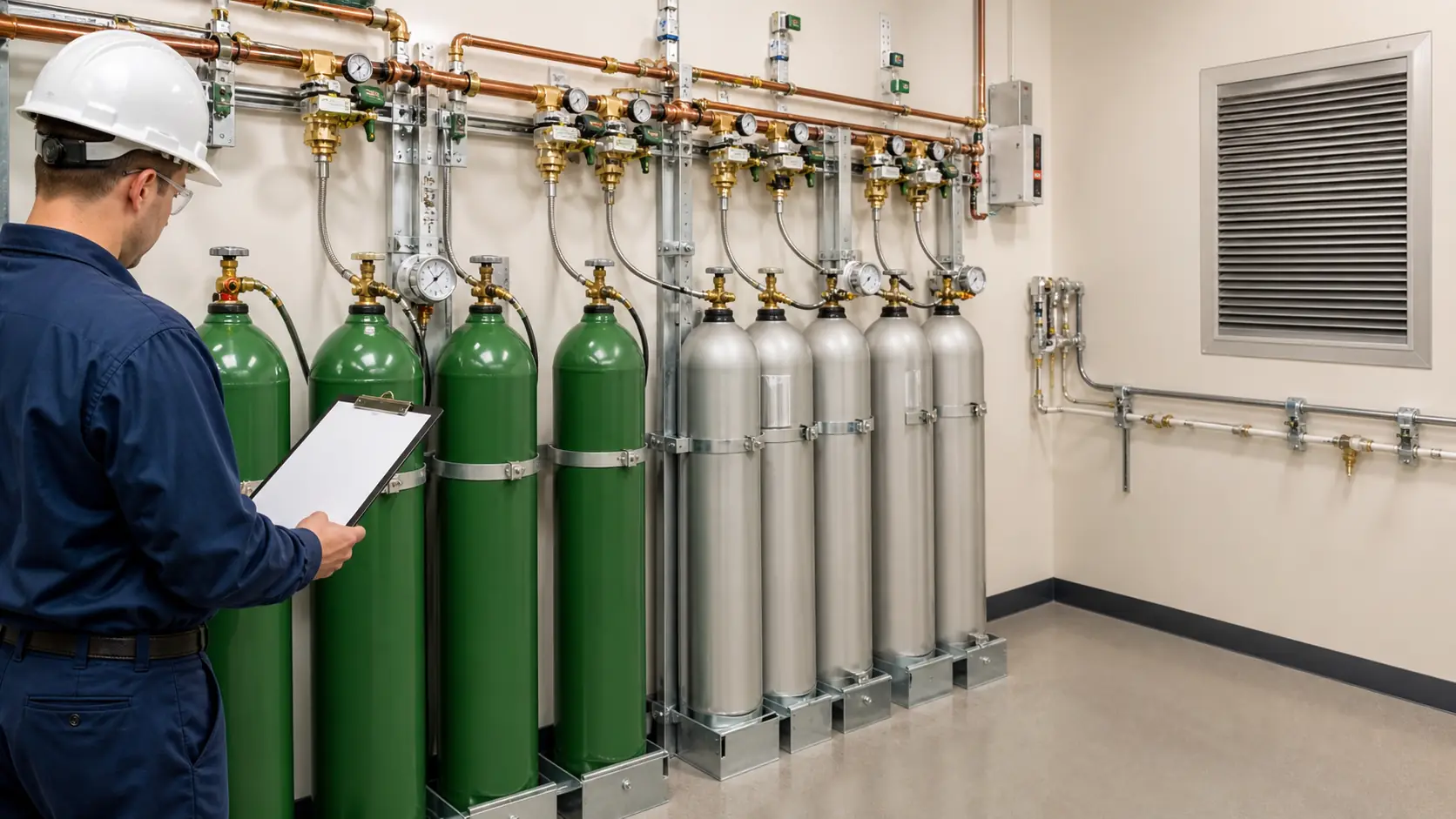
Establish the room and system inventory
Identify bulk systems, central supply locations, manifold rooms, cylinder storage areas, indoor and outdoor enclosures, reserve supplies, zone components, and departments that manage portable cylinders. Record the gas, system function, room identifier, risk category where applicable, drawings, responsible department, and governing edition. Confirm the inventory in the field because renamed rooms, relocated racks, construction, or vendor changes can make records unreliable. Separate observations about the central piping system from portable-cylinder practices so each issue reaches the person who can correct it.123456789
Review construction and separation features
Compare the actual room or enclosure with the approved design and applicable NFPA 99 provisions for its contents and configuration. Observe walls, doors, openings, ventilation, electrical features, temperature exposure, weather protection, access control, signs, and penetrations without assuming that every medical gas space has identical requirements. Check whether later cable or pipe work compromised an enclosure or obstructed a required opening. When the rating, ventilation design, or allowable quantity cannot be established, document the uncertainty and route it for qualified design and authority review rather than assigning a conclusion from appearance alone.123456789
Inspect cylinder handling and storage
Observe how full, partial, empty, and out-of-service cylinders are identified, segregated, secured, transported, and protected from damage or contamination. Review racks, chains, carts, valve protection, combustible storage, ignition sources, housekeeping, and aisle access. Include receiving docks, temporary staging points, patient-care storage, and after-hours practices because the designated room may look orderly while cylinders accumulate elsewhere. Verify that staff and vendors follow the facility procedure and understand escalation for damaged, leaking, unidentified, or improperly stored cylinders. Do not manipulate valves or connections outside the approved medical gas safety process.123456789
Review manifold operation and access
Confirm that manifold equipment, regulators, valves, alarms, reserve arrangements, identification, and service access correspond to the controlled system records. Look for corrosion, impact risk, unauthorized storage, blocked access, unsupported modifications, missing identifiers, and evidence of leakage or maintenance problems. Interview responsible staff about normal supply, changeover, alarm response, emergency isolation, and vendor service. Functional testing and maintenance should be performed by qualified personnel using approved procedures; a visual audit should clearly distinguish what was observed from what requires a documented technical test.123456789
Connect room findings to emergency operations
Medical gas reliability affects clinical care, utility management, fire safety, supply continuity, and emergency response. Verify notification paths for alarms, supply interruption, leaks, construction shutdowns, and vendor delivery problems. Determine how clinical leaders receive status information and how the organization provides interim supply when service is impaired. Review whether emergency plans reflect actual valve locations, reserve capacity, portable-cylinder resources, and staff responsibilities. Coordinate corrective work with patient-care operations so a safety improvement does not create an uncontrolled outage or introduce contamination into the system.123456789
Build evidence that follows the work
A defensible record connects the requirement or facility policy to a stable location, asset, responsible department, completion date, result, deficiency, immediate protection, corrective action, and verified closure. Keep source documents, inspection forms, work orders, photographs where appropriate, vendor reports, and leadership decisions under document control. A signature or invoice proves that an activity occurred, but it does not by itself prove that the correct population was reviewed, the acceptance criteria were met, or every exception was resolved. Sample records against actual field conditions and preserve unresolved limitations as open work rather than allowing them to disappear during report closeout.123456789
Sustain readiness through leadership review
Trend overdue activities, repeat findings, unavailable assets, failed tests, deferred areas, contractor performance, and time from discovery to verified closure. Report material risk and recurring process weaknesses to the Environment of Care committee or other authorized leadership forum with an owner and due date. Reassess the program after construction, equipment replacement, utility changes, incidents, regulatory updates, or accreditation findings. The goal is continuous compliance: staff should be able to retrieve the current record, explain the management process, demonstrate the condition in the field, and show how leaders use results to reduce risk rather than assembling disconnected documents immediately before a survey.123456789
Explore the complete topic
Continue from this article into the connected cornerstone guides, detailed conditions, exact questions, and related services.