
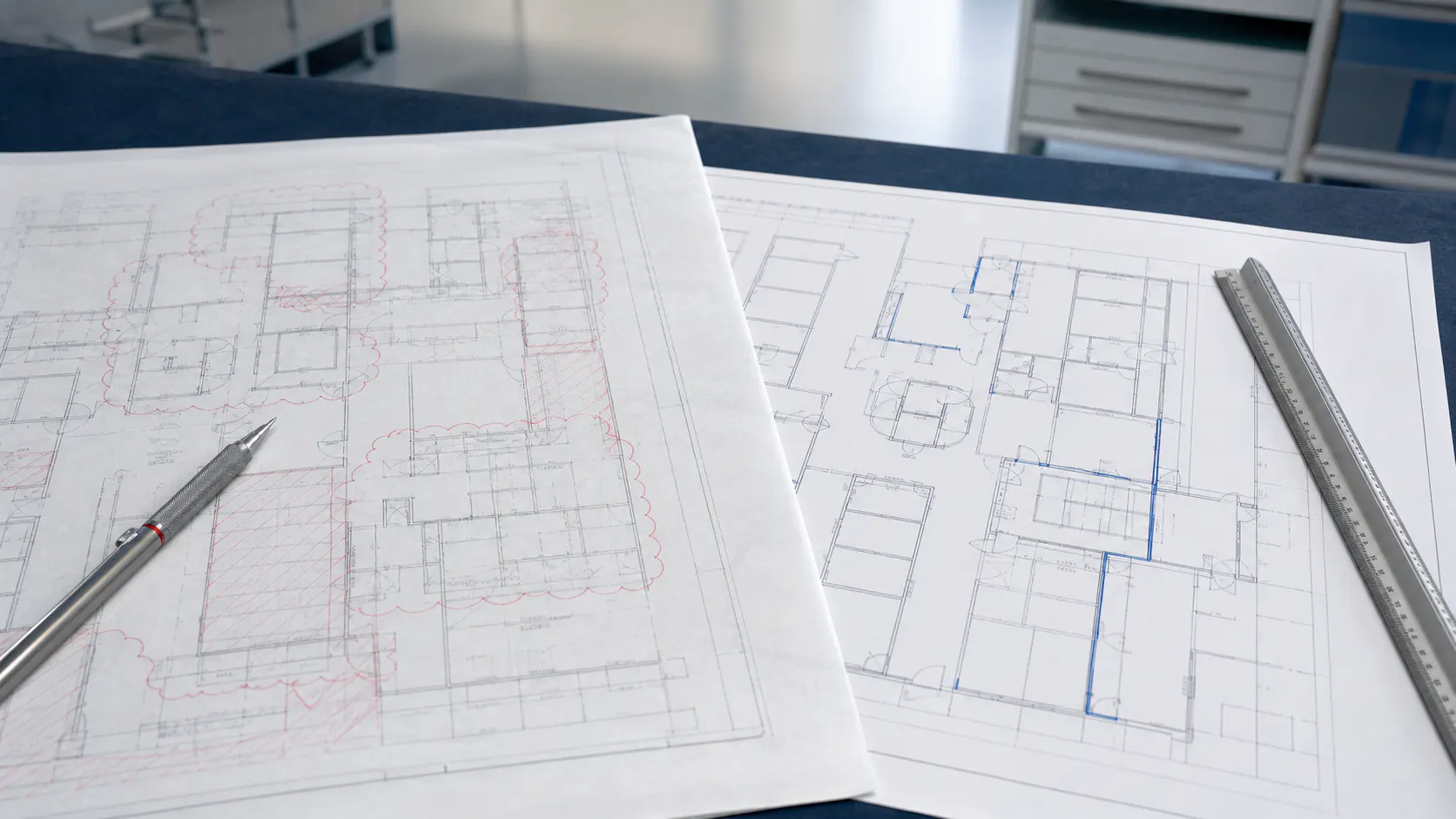
Understand what each record is meant to do
A redline records an observed or proposed difference against an issued drawing. An as-built or record drawing is a formally incorporated representation of verified completed work. Neither label proves accuracy by itself. The facility should define who may create redlines, what evidence supports them, who verifies the field condition, and how the accepted change enters the controlled life safety drawing. The risk begins when a temporary annotation is treated as an approved permanent code conclusion.12345
Redlines are useful during active change
During renovation, investigation, and field verification, redlines create a visible bridge between existing records and emerging conditions. Use a dated controlled base sheet, stable location references, clear colors or markup conventions, author identification, and a concise explanation for every change. Link the markup to the project, work order, photograph, field note, or design decision. Keep unverified assumptions distinct from observed conditions so a reviewer can tell what remains open.12345
The line is crossed when status becomes ambiguous
A redlined plan becomes dangerous when staff cannot tell whether it is draft, verified, approved, superseded, or governing. Multiple conflicting markups, erased history, undated clouds, unexplained barrier changes, and handwritten ratings without supporting analysis are warning signs. If the only plan used for survey, emergency planning, maintenance, or construction control is an aging markup, the facility no longer has a dependable controlled record even if many individual annotations happen to be correct.12345
Field verification is not code approval
A technician can accurately observe that a wall or door exists without establishing the assembly rating, continuity, occupancy basis, suite permission, or means-of-egress compliance. Separate dimensional and location verification from qualified technical evaluation. When a redline changes a fire barrier, smoke barrier, horizontal exit, suite, occupancy classification, or travel path, require review of the governing Life Safety Code provisions and supporting project records before the change is issued as an accepted drawing conclusion.12345
Set conversion deadlines and escalation rules
Define how long a redline may remain open and what events require immediate conversion. High-impact changes affecting exits, compartmentation, patient movement, construction phases, or authority-approved features should not wait for a convenient annual update. Track each markup in a register with owner, status, due date, verification evidence, and target issue. Escalate overdue items, especially where several redlines interact or where temporary conditions have become operationally permanent.12345
Produce a defensible record drawing
Before incorporation, reconcile design documents, approved changes, field observations, inspection results, and remaining exceptions. Update the native CAD or BIM source, regenerate the controlled PDF, complete technical and document-control reviews, and preserve a revision narrative. The final issue should remove rejected proposals, retain traceability to accepted changes, and avoid implying that concealed conditions were verified when they were not. Archive the marked-up evidence with the project instead of leaving it as the active operational sheet.12345
Audit the transition from markup to controlled issue
Sample completed projects and trace each relevant redline through verification, approval, source-file update, PDF release, distribution, and archive. Confirm that field staff, survey escorts, construction teams, and emergency planners can retrieve the same current issue. Look for changes that entered the PDF but not the CAD file, or entered the CAD file but never reached distributed copies. A successful process preserves the speed of redlining while preventing informal annotations from becoming unreviewed facility truth.12345
Explore the complete topic
Continue from this article into the connected cornerstone guides, detailed conditions, exact questions, and related services.