
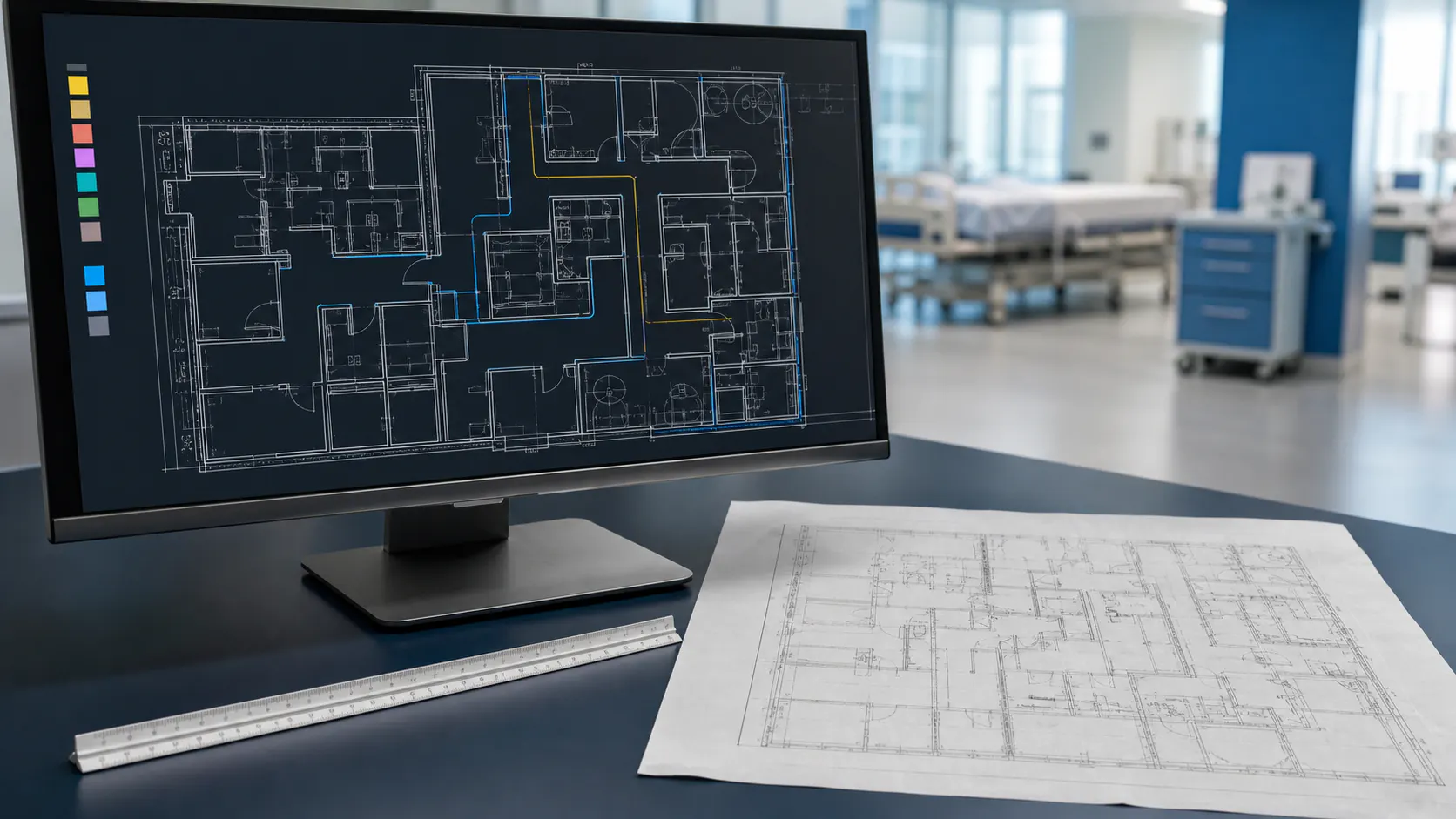
A scan preserves appearance, not drawing intelligence
A scanned PDF can show what a sheet looked like when it was printed, but it usually loses precise geometry, layers, object attributes, searchable text, coordinates, external references, and plotting rules. That loss matters when an audit must trace a barrier, measure an area, reconcile identifiers, or update a changed condition. The scan remains useful evidence of a historical issue, but it is a weak master record for active healthcare life safety drawing management.12345
Native geometry supports verification
DWG and other structured native files allow qualified users to examine scale, coordinates, closed boundaries, distances, areas, and relationships that may be difficult or unreliable in a raster scan. Measurement still requires verified field conditions and competent review; a precise CAD value is not proof that the building matches it. Yet native geometry makes discrepancies visible and repeatable, while a skewed or reduced scan can conceal whether a line, dimension, or travel path is accurate.12345
Layers reveal the drawing's information model
Controlled CAD layers can separate fire barriers, smoke barriers, suites, exits, text, backgrounds, demolition, and project phases. Auditors can isolate functions, test plotting behavior, and identify information omitted from a published view. Layer names alone do not establish compliance, and poorly governed files can be as misleading as scans. A facility CAD standard should therefore define layer purpose, status, color, line type, and required plotted result, with unauthorized or obsolete layers clearly managed.12345
Editable sources make corrections sustainable
When an audit finds an inaccurate barrier, room use, door, or exit path, an editable source lets the facility incorporate the verified correction, preserve identifiers, regenerate the full set, and carry the change into future projects. Editing a scanned PDF often produces patches that cannot be reused or reconciled. Repeated markup cycles gradually obscure history and geometry. Maintaining the native source reduces rework and helps the issued PDF remain a deliberate output instead of an isolated artifact.12345
Structured records improve cross-system reconciliation
Native files can support stable room, door, damper, barrier, and compartment identifiers that map to asset inventories and inspection records. BIM or database links may add further attributes when governed carefully. An audit can compare these relationships and locate missing or duplicate records. The life safety drawing should not become the maintenance database, but the identifiers must align. A scan forces users to interpret labels visually and makes automated or repeatable reconciliation far more difficult.12345
DWG files also carry governance risks
Native files can contain hidden layers, stale external references, unapproved alternatives, embedded paths, or content from older projects. They also require compatible software and skilled reviewers. Treat them as controlled technical records: preserve dependencies, fonts, plot styles, units, coordinate systems, version compatibility, access permissions, and backups. Before accepting turnover, open and audit the package in the facility environment and confirm that the generated PDF matches the approved issue without missing or substituted content.12345
Keep both native files and controlled PDFs
DWG matters more for verification, correction, and long-term stewardship, while the issued PDF is often better for stable distribution and survey retrieval. The strongest program preserves both and ties them together by sheet, revision, issue, and archive record. During an audit, compare native geometry and layers with the controlled PDF, supporting documents, and representative field conditions. If only scans survive, document the limitation and plan a qualified reconstruction instead of pretending the lost drawing intelligence still exists.12345
Explore the complete topic
Continue from this article into the connected cornerstone guides, detailed conditions, exact questions, and related services.