
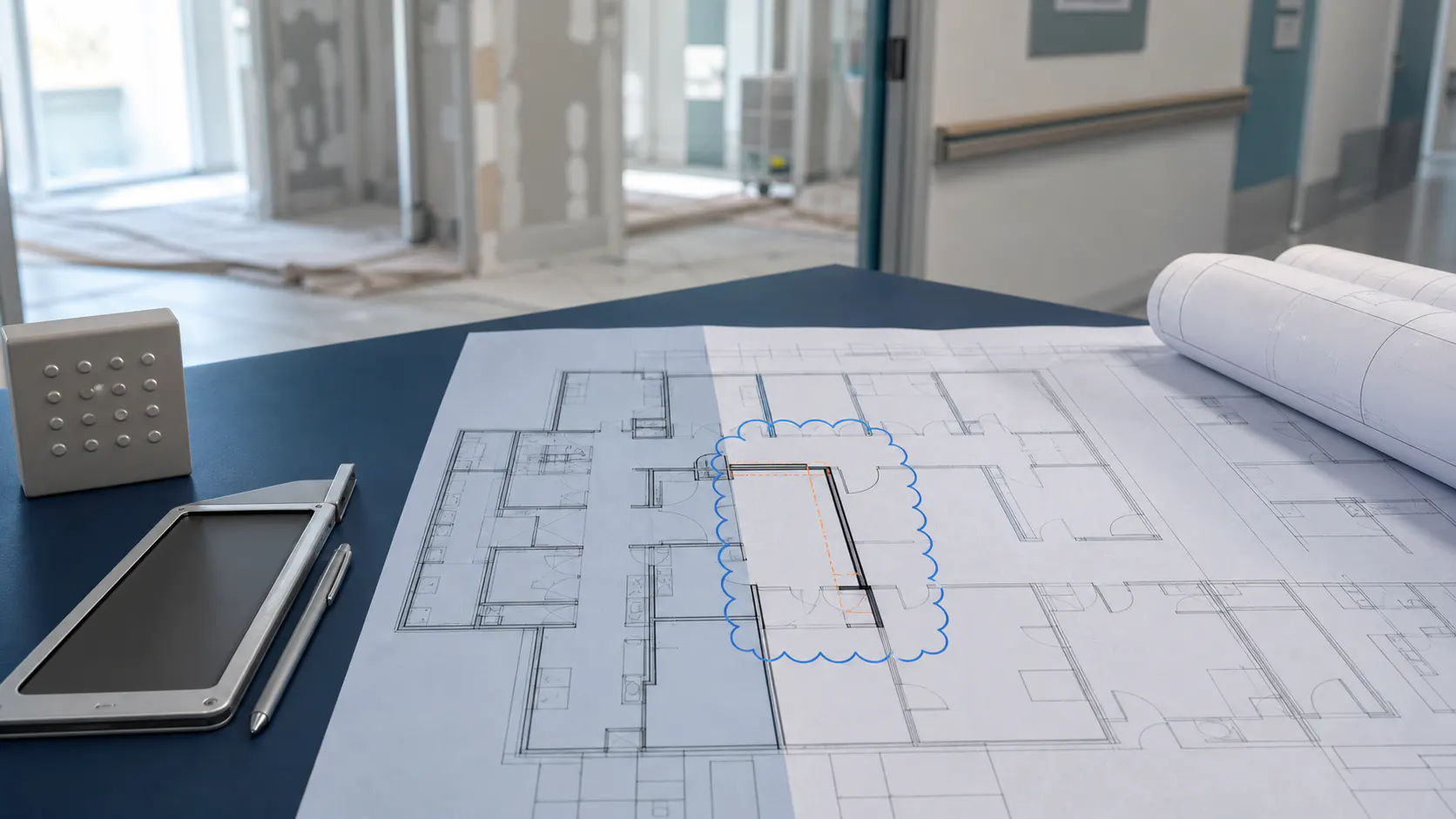
Use trigger-based review instead of a calendar myth
The cited healthcare authorities do not establish one universal rule that every life safety drawing must be redrafted on a fixed annual schedule. The defensible approach is to maintain an accurate controlled record and require review when a project, operational change, discovery, or authority decision could affect it. A periodic audit remains valuable, but it supplements event-driven control. A recently dated plan can still be wrong when the field changed yesterday and the update process was never triggered.12345
Trigger 1: renovation, construction, or demolition
Any project that moves a wall, door, opening, shaft, barrier, suite boundary, room function, or means of egress should trigger drawing review. Include enabling work and temporary phases, not only the final construction package. The facility should compare the approved design, field installation, commissioning and inspection results, and project closeout before incorporating the change. Small departmental projects and maintenance work can affect rated assemblies even when they were not managed as major capital construction.12345
Trigger 2: a change in use or occupancy
A room-name change can be administrative, but a real change in patients, procedures, fuel load, staffing, supervision, sleeping use, or clinical capability may alter occupancy classification, suite eligibility, hazardous-area protection, or egress assumptions. Require facilities and regulatory review before operations change. The life safety drawing should be revised only after the approved compliance path is understood, and the revision record should identify the operational decision that caused the graphic change.12345
Trigger 3: field discovery or survey finding
Above-ceiling inspection, barrier management, door inventory work, a mock survey, or an accreditation visit may reveal that the controlled drawing never matched the field. Record the discrepancy as a finding rather than silently changing the graphic. Determine whether the field must be corrected, the plan must be corrected, or qualified design and authority review is required. Preserve the original observation, affected extent, interim protection, responsible owner, and evidence used to close the discrepancy.12345
Trigger 4: impairment or temporary condition
Long-duration construction barriers, blocked exits, relocated departments, temporary partitions, and impaired fire protection can change how staff understand compartmentation and egress. Issue a controlled temporary life safety plan when the condition materially affects operations or emergency response. Link it to the construction risk assessment and any Interim Life Safety Measures decision. Retire the temporary sheet only after restoration is field-verified and the permanent plan accurately represents the completed condition.12345
Set a periodic reconciliation and release cycle
Even with strong triggers, perform a scheduled reconciliation that samples plans against the field, inventories, projects, and open work orders. Set frequency from facility size, project volume, risk, and history rather than habit. Assign one accountable drawing owner and define review, approval, distribution, and archive responsibilities. Track the age of unresolved redlines separately from the issue date. A plan is current only when the field, controlled file, supporting analysis, and distributed copies tell the same story.12345
Explore the complete topic
Continue from this article into the connected cornerstone guides, detailed conditions, exact questions, and related services.