
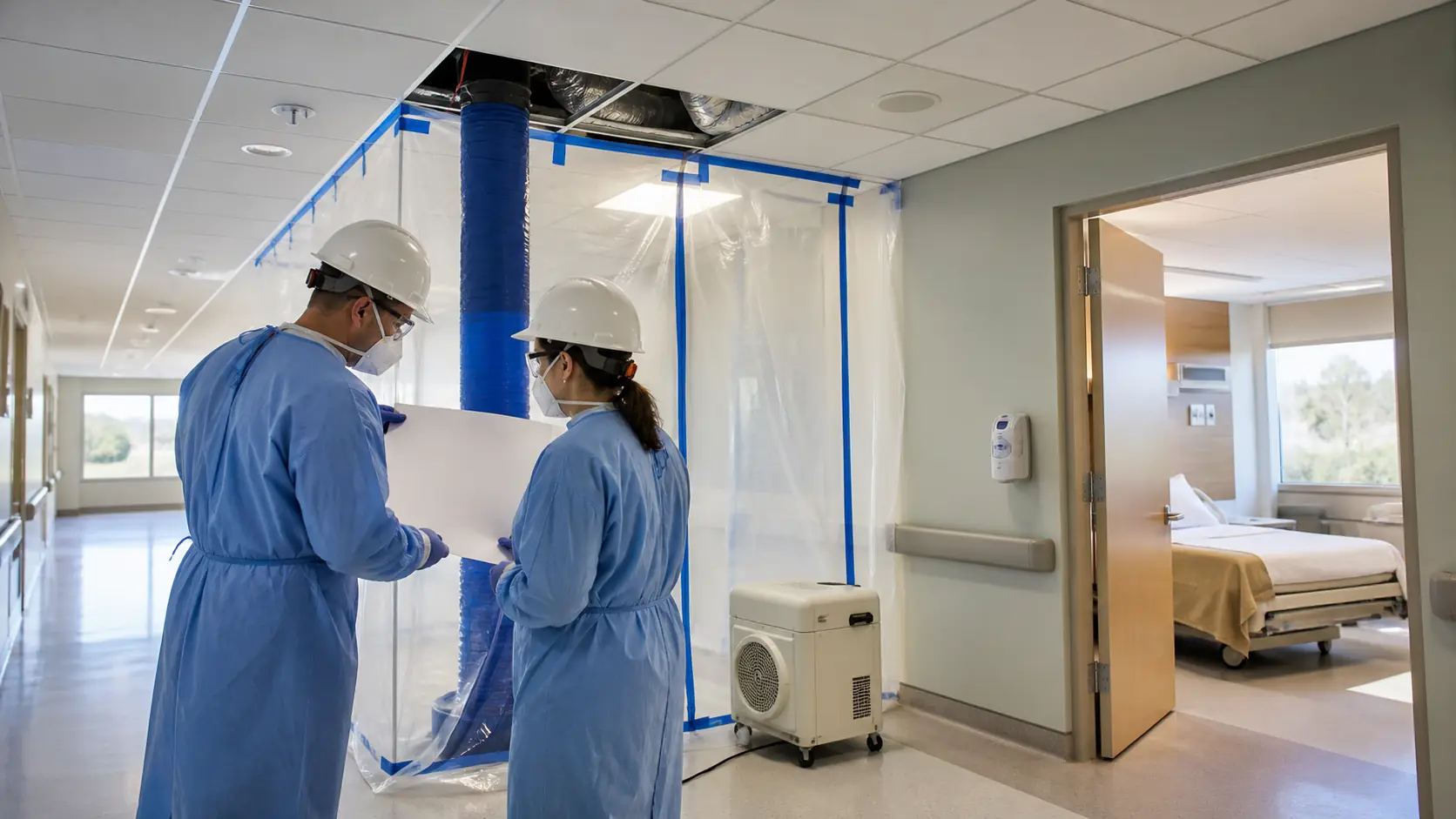
Treat inspection as work in an occupied environment
Lifting a ceiling tile can release dust, disturb pressure relationships, expose utilities, create falling-object risk, and affect patient privacy or care even when no repair is planned. Define the inspection scope, location, duration, access method, and expected disturbance before entering the space. Coordinate with the clinical department and facility safety programs. A life safety objective does not override infection-control or operational safeguards, and an infection-control precaution does not remove the need to investigate a suspected barrier defect.1234567
Complete the infection-control risk review
Use the facility's infection-control risk assessment process to consider patient population, immune status, work classification, dust generation, ceiling condition, adjacent construction, airflow, and environmental controls. Determine containment, cleaning, personal protective equipment, negative pressure, scheduling, and monitoring requirements with qualified infection-prevention personnel. Document the decision with the inspection permit. Avoid assuming that a brief visual check is automatically low risk; repeated tile access across several rooms can create a larger exposure than one planned contained inspection.1234567
Coordinate clinical access and patient protection
Agree on room availability, patient relocation or shielding, quiet periods, equipment movement, medication or sterile-field concerns, and staff escort requirements. Establish a stop-work signal and a process for unexpected clinical needs. Protect beds, devices, and surfaces from dust or debris and maintain required corridor and egress conditions. Inspectors should understand restrictions on photography and patient information. The work plan must reflect real care delivery rather than an empty-room assumption carried forward from a planning meeting.1234567
Preserve life safety systems during access
Identify fire alarm, sprinkler, medical gas, nurse call, electrical, smoke-control, and other utilities near the access area. Do not hang tools or temporary materials from building systems, obstruct sprinklers, damage ceiling assemblies, or move detection components. If inspection requires impairment, system isolation, or opening a rated access assembly, follow the applicable authorization and notification process. Keep exits and corridor width available. Temporary removal of a ceiling tile should not become an uncontrolled condition after the inspector leaves.1234567
Inspect barriers and penetrations systematically
Use the life safety drawing and a defined field route to identify barrier type, continuity, head-of-wall condition, intersections, penetrations, joints, sleeves, ducts, dampers, and access. Record the observed extent and any inaccessible area. Distinguish existing deficiency from damage caused by the inspection. When a suspected defect requires closer investigation, do not enlarge openings or remove firestop without authorization. Create a follow-up scope that includes infection-control and restoration requirements.1234567
Restore the environment before release
Remove debris, clean according to the approved method, reinstall undamaged ceiling tiles and access panels correctly, verify that barriers and systems were not disturbed, and return furnishings or equipment to the agreed condition. Obtain clinical and infection-control release when the facility procedure requires it. Record any unresolved life safety finding with risk assessment and interim action. The work area should not return to patient use merely because the inspector completed observations; restoration and environmental acceptance are separate closeout steps.1234567
Plan recurring audits around care delivery
Coordinate recurring concealed-space audits with maintenance, infection prevention, nursing, environmental services, and construction planning so access can be grouped safely. Use prior findings, project history, leak locations, and high-risk pathways to prioritize areas. Track rooms deferred for clinical reasons and reschedule them rather than treating them as passed. Review whether inspection methods create repeat ceiling damage or contamination concerns. A sustainable program protects patients while still producing credible evidence about concealed barriers and systems.1234567
Explore the complete topic
Continue from this article into the connected cornerstone guides, detailed conditions, exact questions, and related services.