
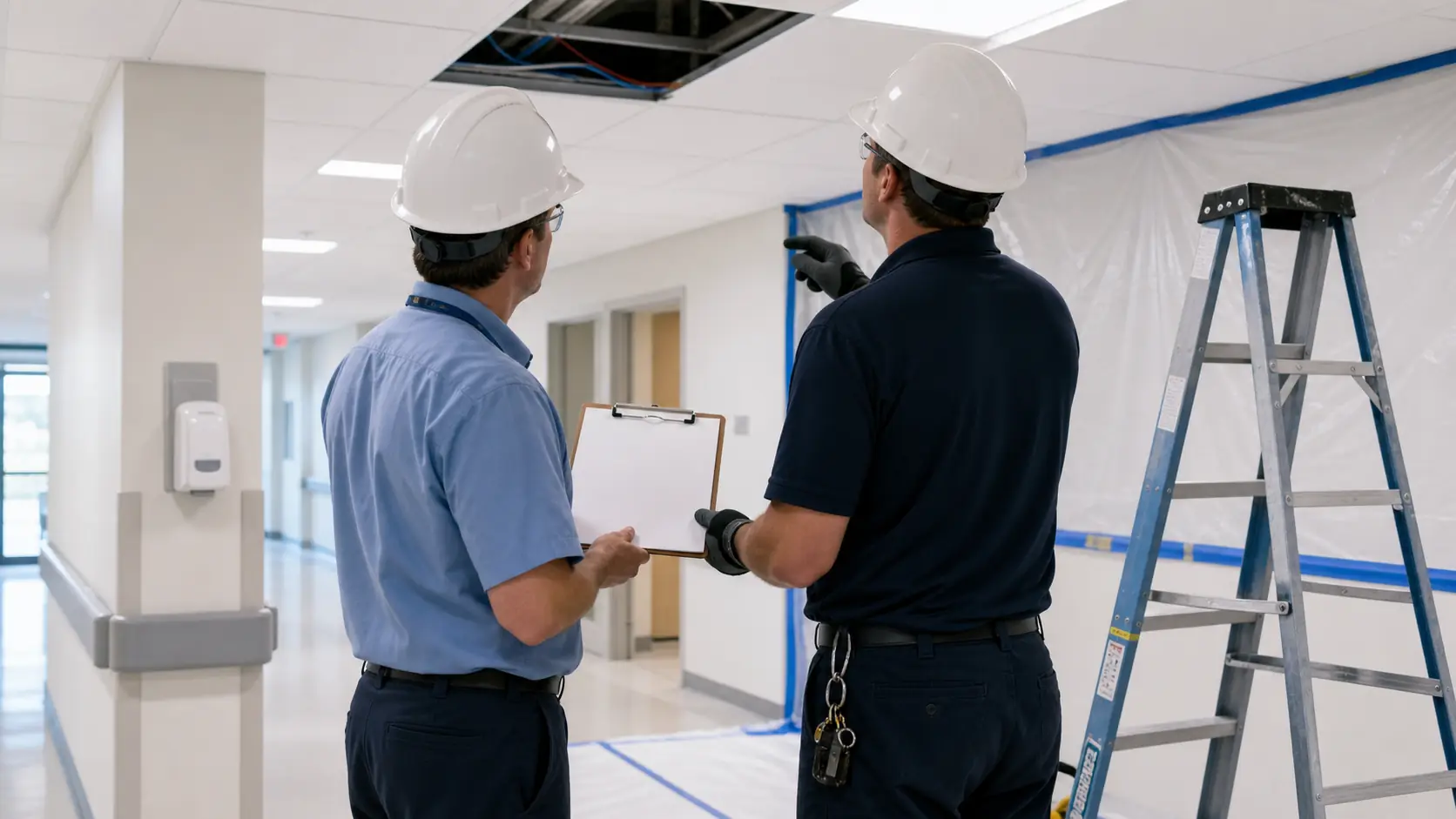
Define what work requires a permit
An above-ceiling permit should apply whenever staff or vendors lift ceiling tiles, open hard ceilings, enter interstitial space, penetrate a wall or floor, disturb a barrier, access a damper, route cable or pipe, or perform work that could affect fire protection or patient-care operations. Define narrow exceptions for observation-only tasks only when they cannot disturb concealed conditions. The permit boundary should apply to internal departments and contractors alike; job title or familiarity does not reduce the risk.1234567
Screen the request before access
Require the requester to identify the exact building, floor, room, ceiling area, work scope, systems affected, expected penetrations, responsible supervisor, workers, schedule, and infection-control impact. Compare the request with current life safety drawings and known fire barriers, smoke barriers, shafts, and hazardous areas. Route the permit for construction risk assessment, infection-control review, utility or fire-protection impairment review, and Interim Life Safety Measures assessment when those programs are triggered. Approval should precede ceiling access, not follow discovery.1234567
Set permit conditions that can be inspected
The permit should state permitted access points, protection requirements, approved pathways, firestop-system documentation, ceiling-tile controls, dust containment, ladder and work-zone limits, housekeeping expectations, and restoration deadlines. Prohibit undocumented penetrations, unsupported cables, damage to sprinkler or alarm components, and use of unapproved sealants. Identify who can stop the work and who must approve changes in scope. Conditions should be specific enough that an inspector can distinguish compliant work from an unauthorized deviation without relying on verbal assurances.1234567
Control identification and visible status
Assign a unique permit number and display it at the work area or make it immediately retrievable through the facility system. Mark the approved ceiling zone on a plan or photograph and connect each new penetration to a stable location. Use start and expiration dates so an open permit cannot remain active indefinitely. When work spans shifts or phases, require a documented handoff. Staff conducting rounds should be able to determine who owns the space, what work is authorized, and whether the ceiling may be closed.1234567
Inspect during work, not only at closeout
Use risk-based interim inspections for long-duration work, concealed conditions, multiple trades, difficult firestop systems, or work near patient-care operations. Verify that access remains within the approved zone, cables and pipes match the permit, sleeves and annular spaces remain suitable for the selected system, and temporary openings receive required protection. Correct deviations before they are hidden. Photographs are useful when tied to the permit and location, but they do not replace qualified observation of the installed system and surrounding barrier.1234567
Require a documented closeout inspection
Before ceiling tiles are replaced or a hard ceiling is closed, inspect penetrations, firestopping, dampers and access doors, barrier surfaces, hangers, cabling, debris, ceiling components, and affected fire-protection devices. Confirm that the installed condition matches the approved system and that labels or identifiers remain visible where required by facility policy. Record deficiencies as work orders and keep the permit open until correction is verified. Closure by the contractor who performed the work is not independent evidence that the concealed space is restored.1234567
Audit the permit program for effectiveness
Trend permits by department, vendor, location, scope, deficiencies, overdue closeouts, and repeat failures. Compare completed permits with random above-ceiling observations to find unpermitted work. Review whether approved penetrations entered barrier and asset records and whether project closeout updated drawings. Train requesters, supervisors, inspectors, and vendors on their distinct responsibilities. A strong permit system is not measured by the number of forms issued; it is measured by fewer concealed defects and reliable evidence that every authorized opening was restored.1234567
Explore the complete topic
Continue from this article into the connected cornerstone guides, detailed conditions, exact questions, and related services.