
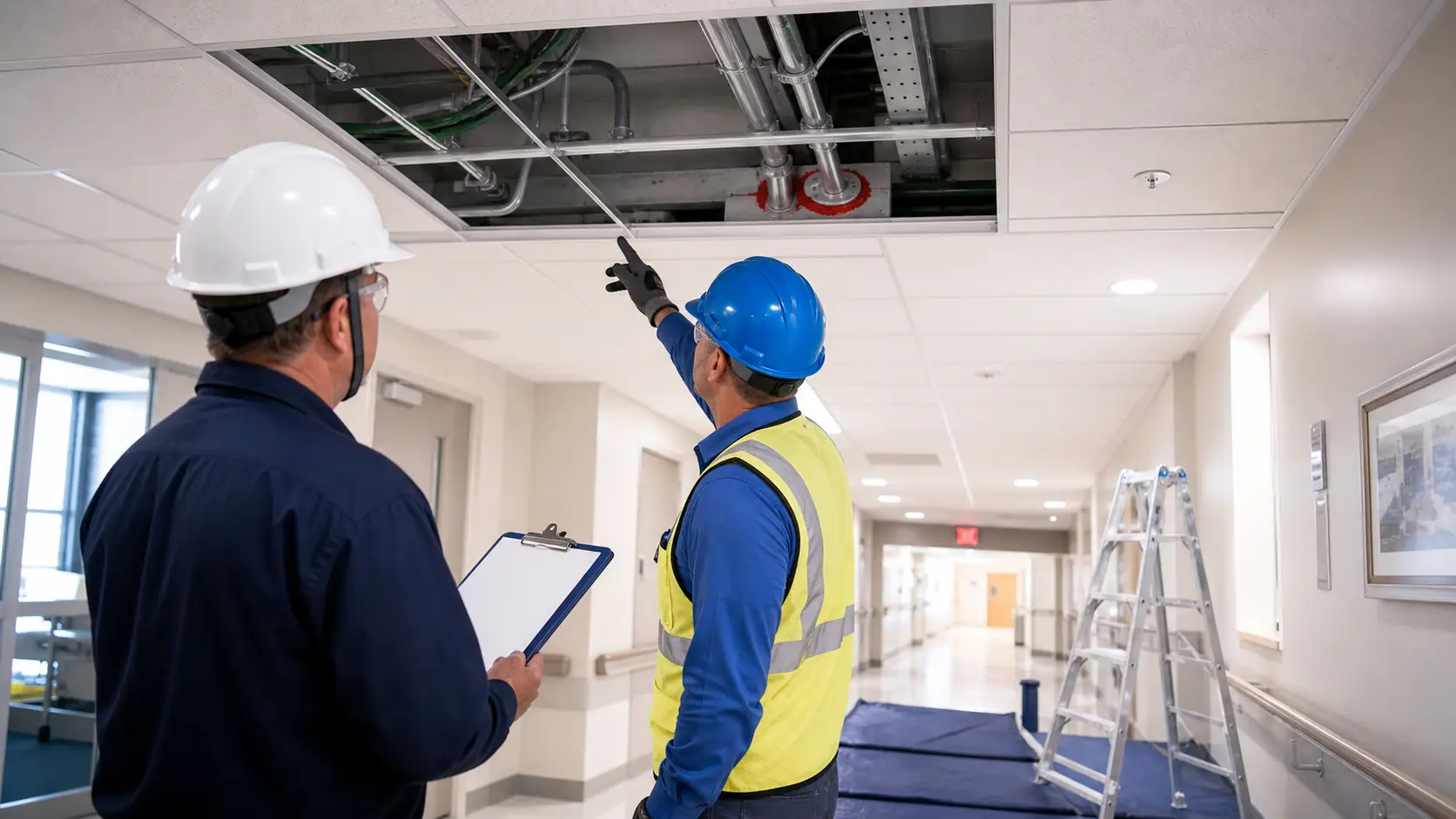
Set the standard before procurement
Include above-ceiling permit, barrier protection, infection-control coordination, approved firestop systems, damper access, labeling, documentation, and closeout requirements in requests, contracts, purchase orders, and project specifications. Define that facility standards apply to subcontractors and service vendors as well as the prime contractor. Avoid relying on orientation after award to introduce requirements that affect price or schedule. Vendors should know who has authority to approve access, stop work, inspect concealed conditions, and reject nonconforming installations.1234567
Prequalify competence for the assigned work
Evaluate relevant training, firestop-system knowledge, manufacturer qualifications where required, damper experience, healthcare infection-control familiarity, safety record, supervision, and past performance. Match competence to scope; a cabling vendor may understand pathways but not barrier classification or firestop selection. Require named responsible supervisors and a plan for subcontractor control. Certificates can support qualification, but they do not replace field performance. Review sample records and ask how the vendor handles conditions that do not match a listed system.1234567
Use project-specific orientation and permits
Before work begins, orient the crew to building access, patient-care restrictions, ceiling controls, identified barriers, approved routes, permit display, infection-control measures, impairment reporting, photographs, housekeeping, and closeout. Confirm understanding with the workers who will enter the space, not only the project manager. Issue permits for defined locations and time windows. Changes in crew, scope, route, or schedule should trigger review. A generic annual vendor badge should not authorize unrestricted concealed-space work across the campus.1234567
Provide approved systems and details
Make current life safety drawings, barrier identifiers, standard details, approved products, and listed firestop systems available at the work area. Require submittal and approval before creating penetrations when system selection depends on opening geometry or penetrating items. Control substitutions. Vendors should stop when the field differs from the approved detail instead of improvising with familiar sealant. Facility reviewers must respond promptly so schedule pressure does not become the reason for concealed undocumented work.1234567
Inspect performance during installation
Use risk-based surveillance to verify containment, access, barrier protection, sleeve and opening preparation, cable or pipe routing, backing material, sealant depth, collars, damper clearance, and housekeeping before the ceiling is closed. Document deviations and require correction while the work remains visible. Do not transfer inspection responsibility entirely to the vendor. Self-inspection is useful, but the facility remains responsible for accepting work that affects its physical environment and ongoing survey readiness.1234567
Require complete turnover and deficiency closure
Closeout should include permit records, installed-system identifiers, location lists, photographs, test reports, inspection results, approved deviations, drawing markups, asset updates, and unresolved items. Verify samples against the field and keep deficiencies open until independently confirmed. Withhold contractual completion or payment milestones when permitted by the agreement and required records are missing. A warranty letter or invoice does not establish that every concealed penetration, damper, and barrier interface was installed and documented correctly.1234567
Score vendors and enforce consequences
Track permit violations, unapproved substitutions, failed inspections, repeat firestop defects, damaged ceiling components, inaccessible dampers, incomplete documentation, response time, and verified corrective performance. Share results with procurement, facilities, safety, infection prevention, and project leadership. Use progressive actions such as retraining, increased inspection, corrective plans, removal of individual workers, suspension, or disqualification under facility policy and contract terms. Reward reliable performance with appropriate trust, but never eliminate verification for work that will become concealed.1234567
Explore the complete topic
Continue from this article into the connected cornerstone guides, detailed conditions, exact questions, and related services.