
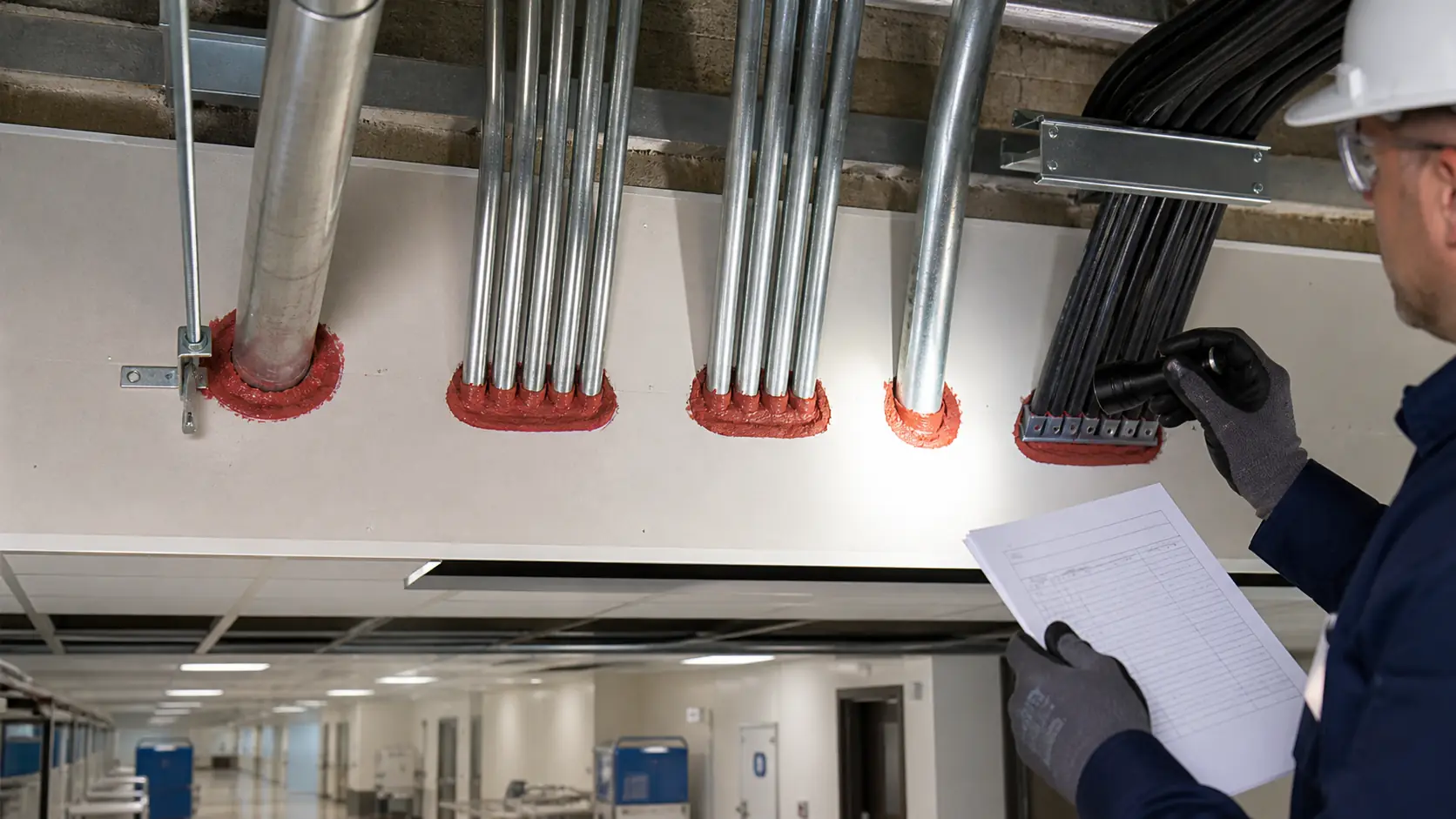
Confirm the barrier before judging the seal
Begin with current life safety drawings and field verification to determine whether the wall or floor is a fire barrier, smoke barrier, shaft enclosure, or unrated partition. Record the required function and rating. A red sealant around a cable does not prove firestopping, and a visible gap in an unrated partition should not automatically be cited as a rated-barrier deficiency. Where the boundary classification is uncertain, separate the condition for technical review before assigning a compliance conclusion.1234567
Identify every penetrating item and opening condition
Record the cable, cable bundle, conduit, pipe, tube, duct, sleeve, insulated service, or mixed penetration that passes through the assembly. Measure or reasonably verify opening shape, size, annular space, penetrating-item dimensions, sleeve type, and material. Note whether the opening is a through-penetration or membrane penetration and whether several items share one opening. A listed system applies to a defined configuration; calling every opening a cable penetration hides the variables that determine whether the installation matches.1234567
Retrieve the complete listed system
Obtain the specific listing or approved system used for the installation, including the tested wall or floor construction, penetrating items, sleeve conditions, annular-space limits, backing material, sealant or device, depth, and installation details. Use the current authoritative listing information and preserve the system identifier with the permit or inspection record. Product packaging alone is not the system. A firestop material can be listed for many uses while the installed combination falls outside every applicable tested configuration.1234567
Compare the field installation component by component
Inspect the barrier construction, stud or masonry details where visible, gypsum layers, opening edges, sleeve, penetrating items, packing material, sealant depth, collars, wraps, devices, and required installation on one or both sides. Look for missing material, incompatible insulation, oversized bundles, added cables, movement, cracking, or repairs placed over an unknown prior system. Do not destroy a compliant installation to inspect it; use records, accessible observations, measurements, and qualified destructive investigation only when authorized and necessary.1234567
Distinguish workmanship from system mismatch
Surface voids, poor adhesion, incomplete coverage, and damaged material are workmanship findings. Wrong pipe material, excessive annular space, unapproved mixed penetrants, missing collars, inadequate depth, or an incompatible wall can mean the selected system does not apply. The corrective response differs: cosmetic tooling cannot repair a fundamental mismatch. Require the responsible party to document a listed alternative, engineering judgment where accepted, field evaluation, or reconstruction appropriate to the governing process rather than adding more sealant around the visible edge.1234567
Document location and evidence for correction
Assign a stable penetration identifier tied to building, floor, room, barrier, and nearby grid or feature. Photograph the overall location and close condition where permitted, record the system identifier, observed configuration, dimensions needed for evaluation, deficiency, risk response, and work-order or permit link. Mark inaccessible and concealed aspects honestly. After correction, verify the same opening and preserve evidence that the complete configuration now matches the accepted system. A close-up photograph without location or system basis is weak closure evidence.1234567
Use sampling to find systemic weaknesses
Select samples across vendors, projects, cable pathways, pipe types, barriers, buildings, and installation periods. Trace each sample from permit and submittal to field condition and closeout. Expand the review when repeated oversized openings, undocumented systems, mixed penetrants, or barrier-classification errors appear. Trend findings by contractor and work type, then update standard details, approved products, training, and permit checkpoints. The audit should improve the barrier-management process, not merely produce a list of isolated red patches.1234567
Explore the complete topic
Continue from this article into the connected cornerstone guides, detailed conditions, exact questions, and related services.