
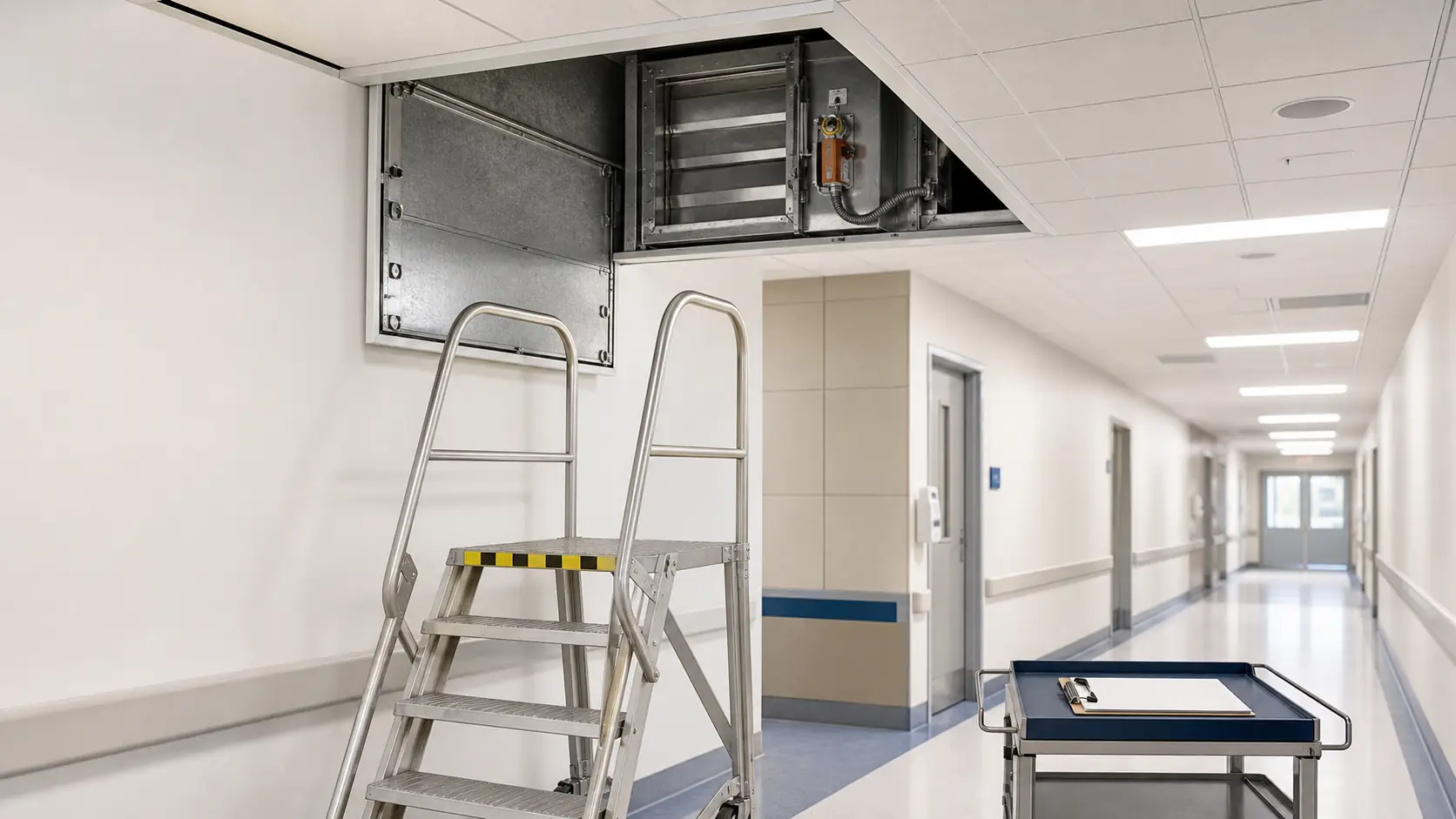
Build the audit from a verified inventory
Start with mechanical and life safety drawings, controls documentation, prior test reports, project closeout, and field observations. Assign each damper a stable identifier, type, barrier function, floor, room, duct, access point, and serving system. Reconcile duplicate identifiers and devices listed in reports but absent from drawings. An accessibility audit cannot be credible when the facility does not know the expected population. Record suspected missing or concealed dampers for qualified investigation rather than deleting them from the list.1234567
Locate the damper and its access point
Trace the duct to the rated or smoke-resisting boundary and confirm the device location. Identify the ceiling tile, access panel, duct door, shaft access, or other route used for inspection and testing. The access point should lead to the correct damper without forcing technicians to guess among several devices. Marking the ceiling grid or maintaining a location photograph can help when controlled. Do not place permanent labels where they create patient-care, infection-control, or architectural conflicts without facility approval.1234567
Evaluate safe approach and working clearance
Inspect the route for ceiling height, ladder placement, patient-care interference, equipment, piping, cable trays, sharp edges, energized components, and other obstacles. Determine whether a technician can reach the access opening, view required components, operate the damper, and restore it safely. Accessibility is not established merely because a small panel exists. Coordinate specialized access, containment, lift use, shutdowns, or clinical scheduling where needed, and document locations that require more than routine access.1234567
Inspect ceiling and duct access doors
Verify that access doors are present where required, large enough and positioned for the intended inspection, operable, secured, and compatible with the surrounding assembly. Confirm that ceiling panels, shaft doors, and duct access doors do not compromise required ratings. Look for doors blocked by new utilities or furnishings, painted shut, missing fasteners, or installed on the wrong side of an obstruction. The opening should allow inspection without cutting the duct or damaging fireproofing during each test cycle.1234567
Confirm access to operating components
The technician should be able to observe blades and tracks as required, reach linkages, actuators, fusible links or heat-response devices as applicable, and operate or reset the damper under the adopted procedure. Combination fire-smoke dampers may also require access to actuators, detectors, and controls interfaces. Record which functions can and cannot be reached from the existing access point. A report that marks the damper tested without identifying inaccessible components can mask an incomplete examination.1234567
Reconcile accessibility with inspection logs
Compare the field route, device identifier, access point, test date, result, deficiencies, and technician notes with prior logs. Investigate reports that show repeated tests despite a visibly inaccessible device, identical generic notes across many dampers, or inconsistent locations. Record deferred or partially tested devices separately from passes. Link access corrections to work orders and preserve photographs or plans that help the next technician. Documentation should demonstrate what was reached and tested, not simply that a contractor visited the floor.1234567
Correct access problems before the next cycle
Prioritize inaccessible life safety devices based on barrier function, current test status, failure history, and safe work planning. Coordinate access-door installation, utility relocation, ceiling modification, labeling, and drawing updates through approved construction and barrier-management processes. After correction, verify the complete test and update the inventory. Trend recurring causes such as uncoordinated renovations, added cable trays, or inadequate original access. Designing maintainability into projects is more reliable than rebuilding access at every inspection interval.1234567
Explore the complete topic
Continue from this article into the connected cornerstone guides, detailed conditions, exact questions, and related services.