
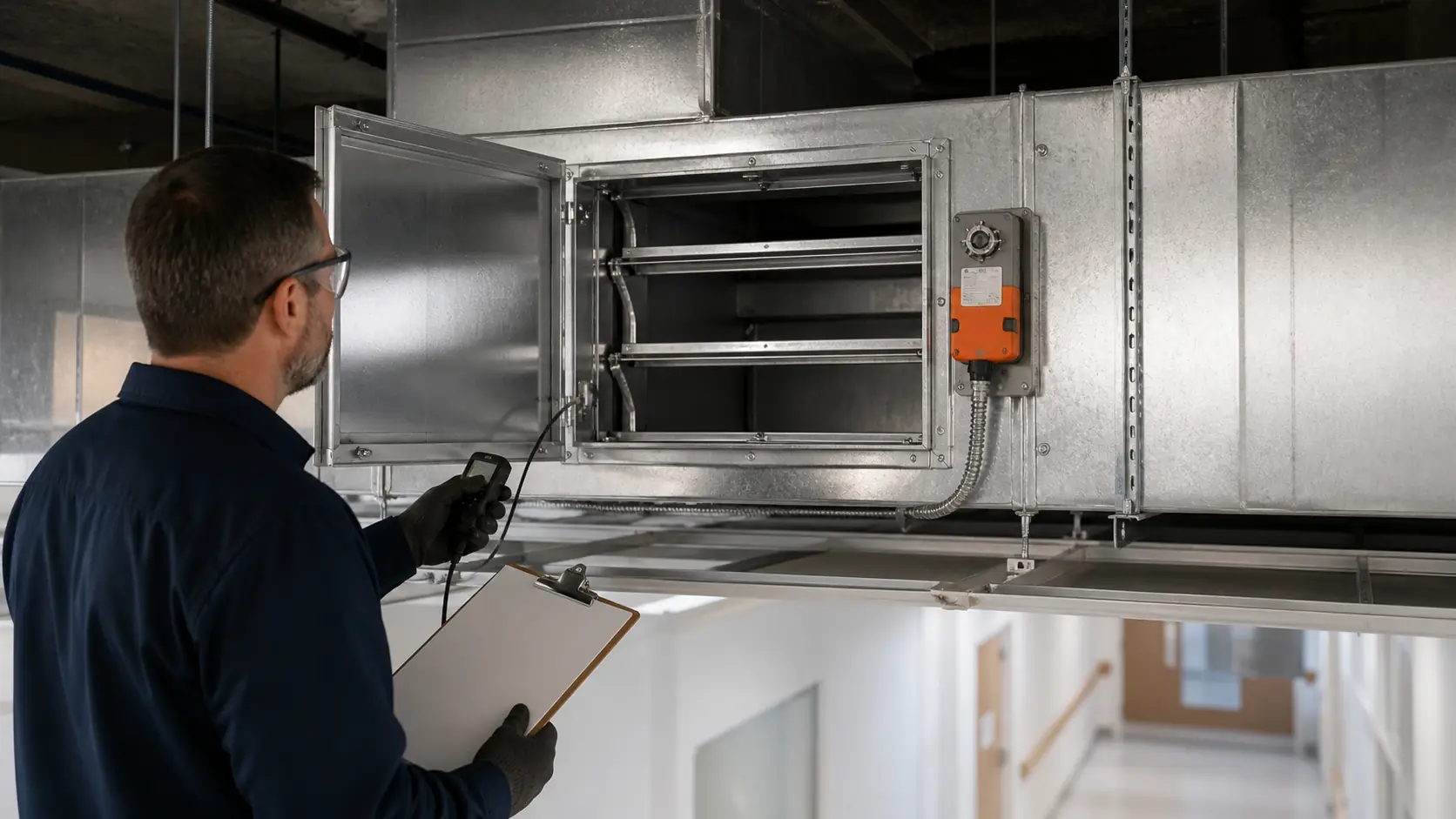
Do not reduce the rule to one interval
Damper testing depends on damper type, installation status, occupancy, adopted editions, and the referenced standard. The familiar one-year and four-year numbers describe different points in the testing sequence, and hospitals may qualify for a six-year periodic interval under the applicable NFPA provisions. Begin by confirming whether each device is a fire damper, smoke damper, or combination fire-smoke damper and whether the facility is a hospital or another healthcare setting before assigning a due date.1234567
Start with acceptance testing
New and relocated dampers should be inspected and tested as part of installation and project acceptance before the system is relied upon. Verify the approved location, damper and sleeve, retaining method, breakaway connections, access, actuator, detector or control interface, and unobstructed operation. Preserve the test result with project turnover and add the device to the controlled asset inventory. Acceptance testing cannot be replaced by placing the new damper on a future periodic schedule while installation defects remain concealed.1234567
Understand the one-year milestone
The one-year requirement is generally the first periodic inspection and test after installation, not a universal annual test forever. It provides an early opportunity to identify construction debris, shifting ductwork, binding blades, actuator problems, inaccessible access panels, or documentation gaps that emerge after occupancy. Calculate the date from the verified installation or acceptance milestone defined by the governing program. If that date is unknown, document the uncertainty and establish a qualified recovery plan rather than inventing an unsupported service history.1234567
Apply the four-year general interval correctly
After the one-year test, the commonly referenced periodic interval is four years for applicable fire and smoke dampers outside the hospital exception. Healthcare is broader than hospital occupancy: ambulatory, clinic, business, and other provider settings may not qualify for the same exception. Confirm the adopted NFPA 80 and NFPA 105 editions, device type, building use, and authority expectations. A contractor schedule that labels every medical building hospital can produce overdue assets or intervals that are not defensible.1234567
Account for the hospital six-year exception
Hospitals are commonly permitted a six-year periodic interval after the initial one-year test under the applicable NFPA damper provisions. This exception does not erase acceptance testing, the first-year test, or corrective action for known failures. It also should not be applied automatically to detached business occupancies or non-hospital provider spaces without confirming the code path. Record the basis for each interval at the building or asset level so staff can explain why two devices on one campus have different due dates.1234567
Test the complete device and interface
A periodic test should confirm access, identification, freedom from interference, full closure and reopening where applicable, actuator and linkage condition, fusible-link or heat-response components as appropriate, and the smoke-control or fire-alarm interface required by the design. Follow the adopted standard and manufacturer instructions without creating unsafe system conditions. Record inaccessible, untested, or failed functions explicitly. Returning a device to normal and confirming system status are part of the test, not optional cleanup.1234567
Build an interval-controlled inventory
Maintain a stable damper identifier, type, barrier function, location, access point, serving system, installation or acceptance date, interval basis, previous test, next due date, result, deficiency, and closure evidence. Reconcile the inventory with life safety drawings, mechanical plans, controls lists, and field sampling. Trend missing dampers, inaccessible panels, repeated failures, and excluded devices. A reliable schedule comes from verified asset attributes and governing rules, not from applying one spreadsheet formula to the entire healthcare campus.1234567
Explore the complete topic
Continue from this article into the connected cornerstone guides, detailed conditions, exact questions, and related services.