
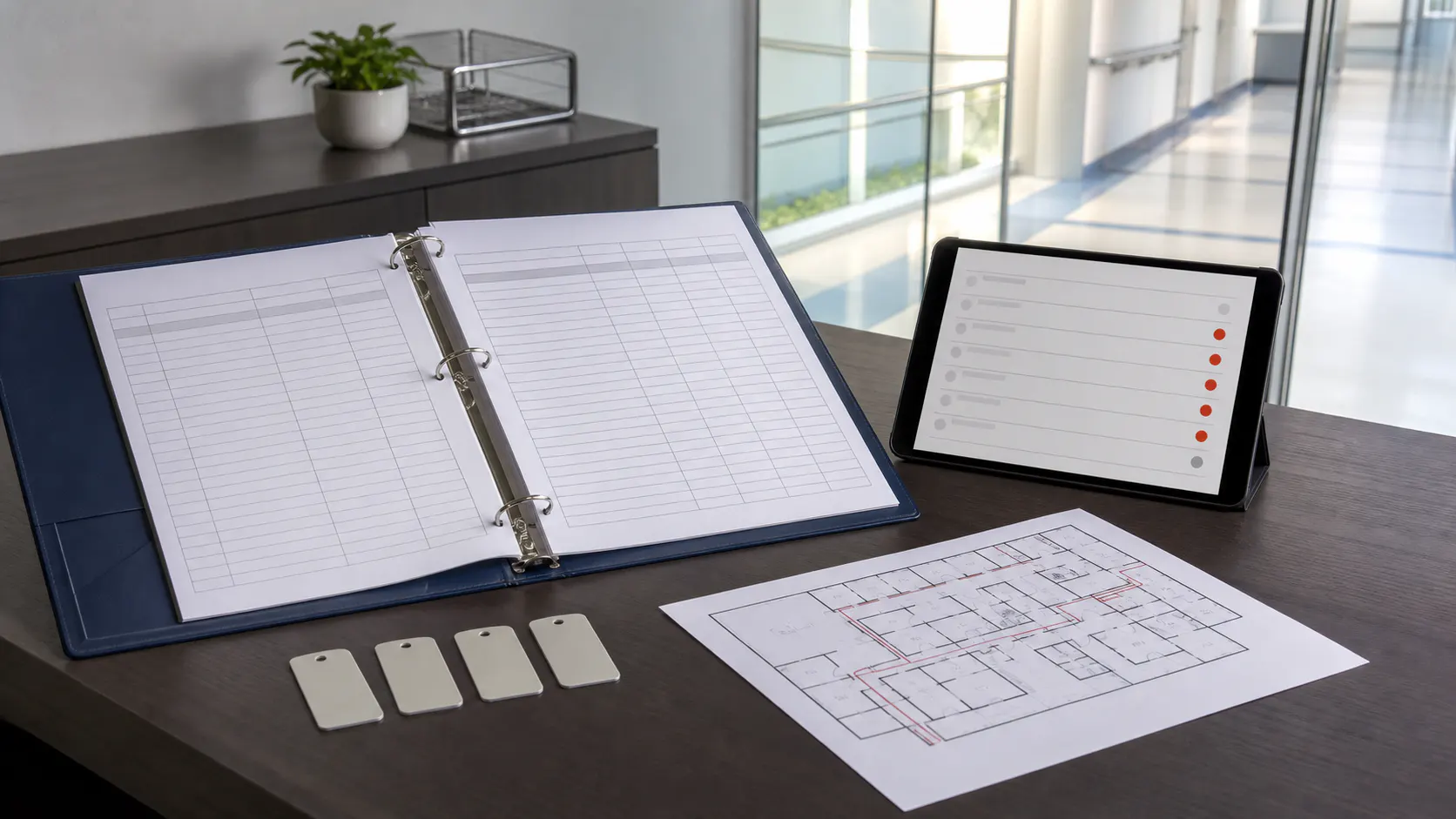
Prove the inspection population
A survey-ready log begins with a controlled inventory of rated fire-door assemblies, not merely the doors a contractor happened to inspect. Each record should connect a unique identifier to building, floor, opening location, barrier function, leaf and frame ratings, configuration, and relevant hardware. Reconcile the log to life safety drawings, prior reports, construction closeout, and field labels. Explain additions, removals, duplicates, and inaccessible openings so the annual population can be reproduced.215
Record the required activity and accountable person
Identify the inspection date, facility and building, inspector name and organization, qualifications or competency evidence maintained by the facility, governing criterion, and report issue date. Preserve enough information to show that the inspection occurred within the annual cycle and covered the complete assembly. Electronic signatures and contractor portals can be acceptable when records are controlled and retrievable, but an exported summary should not hide the underlying observations, exclusions, measurements, or person who performed the work.124
Show item-level results
For each opening, document labels; holes and breaks; glazing; door, frame, and hardware condition; clearances; self-closing or automatic-closing operation; pair sequencing; latching; auxiliary hardware; field modifications; and other applicable NFPA 80 criteria. Use pass, fail, not applicable, and not inspected deliberately, with comments where the result cannot stand alone. Record actual clearance measurements for failures and precise deficiency descriptions. A single overall check mark cannot demonstrate which functions were observed.127
Preserve deficiencies and limitations
Do not issue a clean summary that omits failed items contained in technician notes or attachments. Carry every deficiency, inaccessible component, unverified label, and test limitation into the facility's corrective-action register. Identify the exact opening, failed criterion, risk or interim response, owner, target date, and work-order reference. CMS identifies annual fire-door inspection deficiencies under K211, and survey review can connect the record to the actual door; vague descriptions such as 'adjust hardware' are difficult to verify.278
Link correction to the original finding
Evidence should show what was repaired, by whom, under what approved method, with which component, and when. Attach manufacturer, listing-agency, field-label, or product information when relevant. Then document reinspection and retesting at the same opening, including final measurements and closing or latching results. An invoice, work-order closure, or photograph may support the file but does not by itself prove that the complete assembly was restored.135
Make the log retrievable and auditable
Maintain the authoritative report, inventory, deficiencies, repair evidence, and verification in a controlled repository with retention that satisfies governing requirements and facility policy. Use stable identifiers across drawings, labels, inspection software, and work orders. During readiness drills, retrieve a representative door from the drawing, show its annual result, explain any deficiency, and locate closure evidence. Also select a report row and find the correct physical opening. Both directions should work without guesswork.856
Audit the program before survey activity
Check for missing buildings, doors added by projects, duplicate identifiers, blank criteria, identical copied comments, inspections performed outside the cycle, unresolved failures, and repairs without verification. Compare year over year for doors that disappear, repeatedly fail, or suddenly change rating. Review a sample in the field. The most persuasive inspection log is not the prettiest spreadsheet; it is a complete, traceable record that agrees with the installed openings and demonstrates durable corrective follow-through.2346
Explore the complete topic
Continue from this article into the connected cornerstone guides, detailed conditions, exact questions, and related services.