
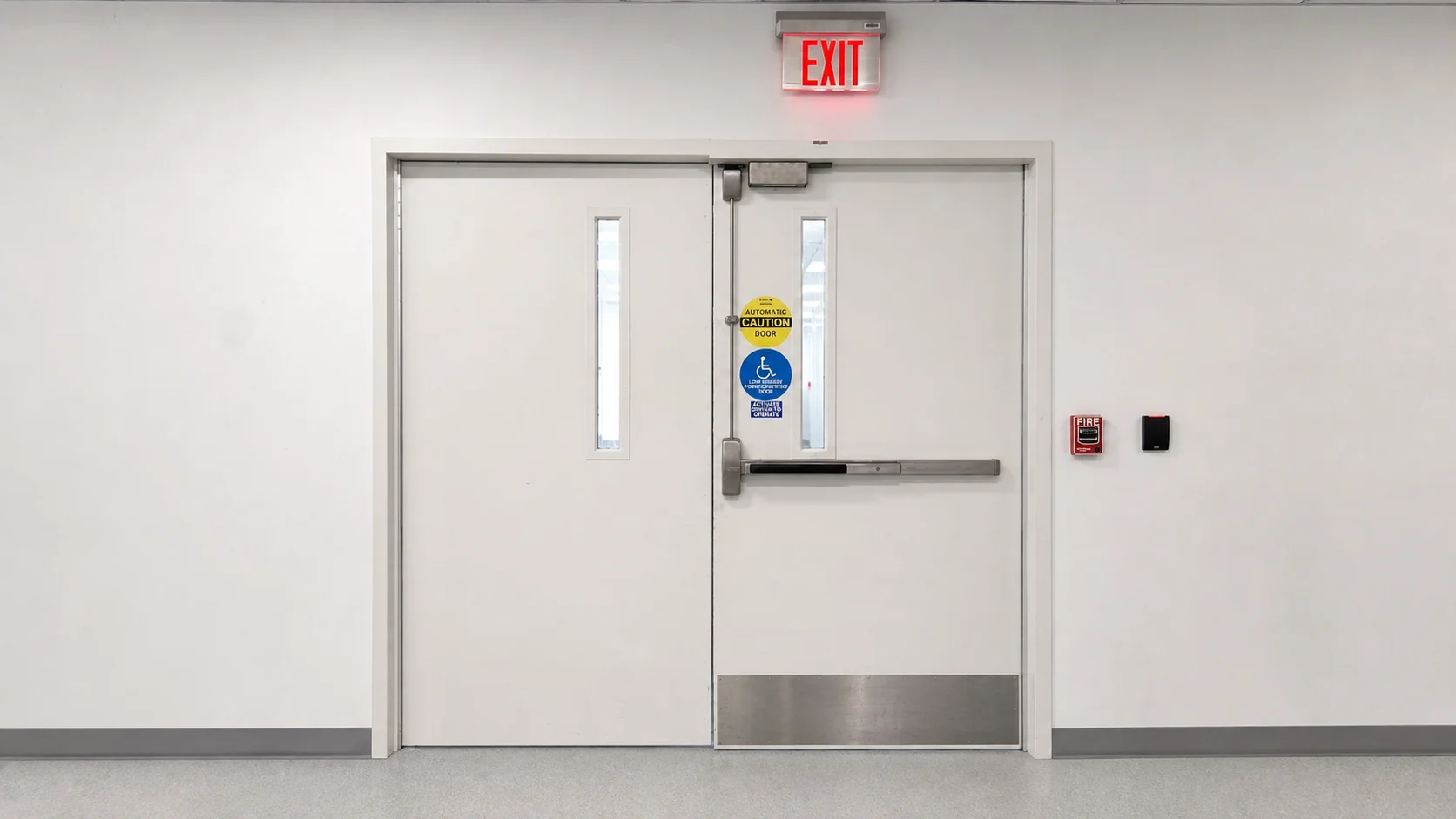
Determine Which Door Assemblies Require Annual Inspection
CMS S&C 17-38-LSC states that fire door assemblies in health care occupancies must be inspected and tested annually under 2010 NFPA 80 through the 2012 Life Safety Code. CMS associates deficiencies involving this annual inspection and testing requirement with K211.
CMS also distinguishes these assemblies from non-rated corridor doors to patient rooms and non-rated smoke-barrier doors. Those non-rated doors are not subject to the same annual NFPA 80 or NFPA 105 requirement described in the memorandum, although they remain subject to routine facility maintenance and any other applicable requirements. Teams should classify each opening before placing it in an annual NFPA 80 inspection population.7895
Reconcile the Door Inventory with Life Safety Drawings
A controlled door inventory should connect each assembly to a unique identifier, location, rating or function, and inspection history. The inventory should be reconciled with current life safety drawings and available design records so that the inspection population reflects the protected openings in the facility rather than only the doors with readily visible labels.
The Joint Commission’s hospital document-review resource calls for current and accurate drawings that identify relevant fire-safety features. When the inventory, drawing, label, or field condition conflicts, the opening should be marked for further review rather than assigned a passing or failing result under an assumed classification.8710
Set Inspection Criteria from the Adopted Edition
Before fieldwork begins, the team should identify the code edition, inspection standard, and criteria that apply to the selected population. For the CMS path described in S&C 17-38-LSC, that generally means the 2012 NFPA 101 framework and the inspection and testing provisions of 2010 NFPA 80. Other authorities may establish a different adopted path.
A fire door assembly includes the door, frame, hardware, and other components that protect the opening. The field process should therefore evaluate the complete assembly and its required operating features under the applicable criteria, rather than treating the door leaf as the entire inspection subject. Conditions that cannot be evaluated should be recorded as incomplete or requiring additional review, not silently counted as compliant.857
Create Location-Specific Inspection Records
Inspection records should allow a reviewer to connect each result to a specific opening. A practical record includes the door identifier and location, assembly classification, inspection date, criteria or edition used, observed conditions, result, inaccessible or unevaluated items, corrective-action status, and the person or organization performing the work. These fields are a documentation practice; the governing authority and adopted standard determine the required record content.
Photographs can clarify observed conditions, but they should remain linked to the written record and door identifier. A completeness review should confirm that every assembly in the controlled population has a traceable result and that omitted, inaccessible, or uncertain openings are clearly identified. CMS survey procedures and accreditation document reviews make reliable records important to both offsite preparation and onsite verification.7101113
Separate Fire Door Findings from Other Door Conditions
Not every healthcare door is governed by the same inspection criteria. Non-rated corridor doors, non-rated smoke-barrier doors, swinging fire doors, and other opening protectives should not be combined into one population without confirming their functions and applicable standards. Other opening types, including rolling steel fire doors or vertical fire shutters, may require inspection and testing steps different from those used for swinging assemblies.
An annual fire door inspection also does not resolve every issue associated with the opening. Locking arrangements, means-of-egress conditions, hold-open functions, and other operating features may require evaluation under additional NFPA 101 provisions and CMS survey tags. Findings should identify the criterion being evaluated instead of treating every door-related condition as an NFPA 80 deficiency.89512
Assign Corrective Actions to the Original Opening
Each deficiency should remain connected to the original door identifier, location, observation, and applicable criterion. The corrective-action record should identify what was done, when it was completed, and what evidence supports closure. A closed work order alone may show that work was performed, but it does not necessarily demonstrate that the complete assembly was reevaluated against the applicable criteria.
After a repair or adjustment, the facility should verify the affected assembly functions and conditions under the adopted inspection standard. Program review should also look for recurring conditions, such as repeated operating problems or inventory changes that were not reflected on drawings, because those patterns may require improvements to preventive maintenance, project turnover, or document control.87111
Prepare Evidence for CMS and Accreditation Review
CMS Form 2786R organizes Life Safety Code survey findings by K-tag, and CMS identifies K211 in connection with annual fire door inspection and testing deficiencies. Survey-ready evidence should make it possible to trace the required population, annual activity, findings, corrective work, and verified closure without relying on an undocumented explanation during the survey.
The Joint Commission publicly identifies annual fire door testing at EC.02.03.05, EP 25, while its document-review tool should be checked for the current program year. A DNV-accredited organization should verify the current NIAHO Physical Environment requirements; DNV’s cited official page identifies Revision 25-1 (Updated), effective September 8, 2025, but directs users to the current publication. Facilities should not assume that CMS, Joint Commission, and DNV use identical document formats or response processes.12710111413
Respond to Findings and Maintain Continuous Control
When CMS documents a deficiency on Form CMS-2567, CMS states that the institution is given 10 calendar days to respond with a Plan of Correction for each cited deficiency. The response should address the cited condition, correction process, completion information, and evidence expected by the applicable CMS procedure. Accreditation findings should be handled under the organization’s current program-specific process rather than assuming the CMS timeline applies.
Annual completion should not be treated as the end of door management. Inventory changes, construction work, repairs, damaged labels, and operating problems can affect the inspection population or assembly condition between annual cycles. Continuous control requires coordination among life safety drawings, the door inventory, work orders, repair verification, and the next inspection cycle.15167131014
Frequently asked questions
How often must healthcare fire doors be inspected?
CMS S&C 17-38-LSC identifies annual inspection and testing for fire door assemblies in health care occupancies under 2010 NFPA 80 and the 2012 NFPA 101 framework. Confirm the facility’s provider type, occupancy, adopted edition, and jurisdictional requirements before applying that interval to a particular opening.7854
Which healthcare doors require annual NFPA 80 inspections?
The CMS memorandum applies the annual requirement to fire door assemblies in health care occupancies. It states that non-rated patient-room corridor doors and non-rated smoke-barrier doors are not subject to that same annual NFPA 80 or NFPA 105 requirement, although they still require routine maintenance and may be governed by other provisions.789
What should a fire door inspection record contain?
A practical record should identify the opening and location, inspection date, assembly classification, criteria used, observed conditions, result, unresolved items, corrective action, and closure evidence. The adopted standard and governing authority determine the required content, while CMS and accreditation resources should be checked for current survey-document expectations.7101113
What is the acceptable clearance under a healthcare fire door?
A universal clearance value should not be assigned from this evidence alone. The facility must use the criteria in the applicable adopted edition of NFPA 80 and confirm that the criterion applies to the specific assembly and condition. Verify the adopted edition before documenting a clearance as compliant or deficient.874
Who is qualified to perform a healthcare fire door inspection?
The cited public evidence does not establish one universal job title or credential for every facility and jurisdiction. Confirm the personnel qualification provisions in the adopted NFPA 80 edition, along with state, local, CMS, and accreditation-program expectations. The facility should document the basis used to select the inspector.810144
How should a facility respond to a K211 fire door finding?
Trace the cited condition to the affected opening, correct the deficiency, reevaluate the assembly under the applicable criteria, and retain evidence of completion. If CMS issues Form CMS-2567, CMS states that the institution has 10 calendar days to respond with a Plan of Correction for each cited deficiency. Other authorities may use different response procedures.7121615
Related guidance for your next step
Explore the complete topic
Continue from this article into the connected cornerstone guides, detailed conditions, exact questions, and related services.