
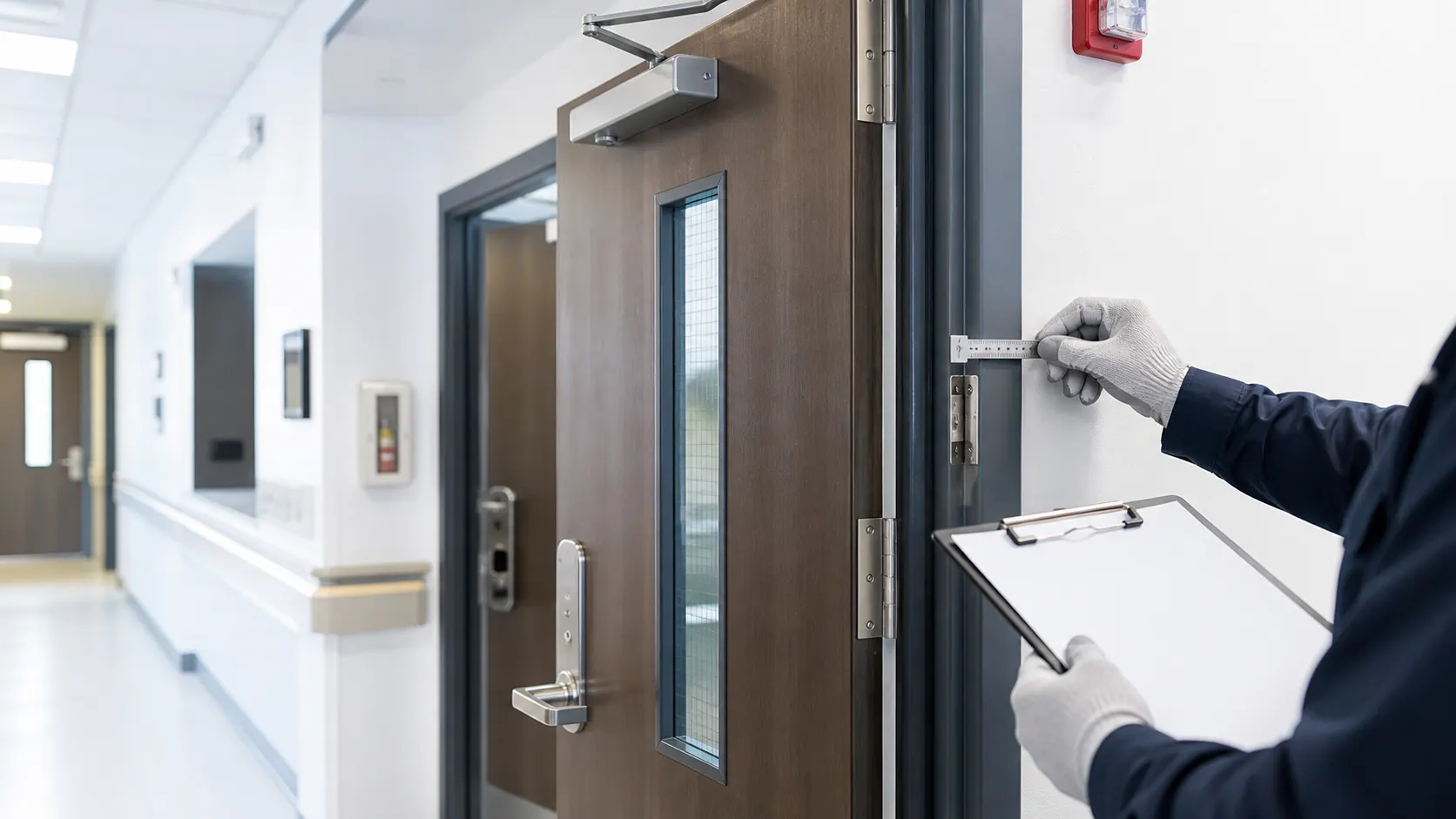
Confirm the Opening Belongs in the Annual Inspection Population
Before documenting an exception, confirm that the opening is a fire-door assembly subject to the applicable annual inspection and testing program. Under the CMS pathway for health care occupancies, fire-door assemblies are inspected and tested annually using the 2010 edition of NFPA 80. The opening should be reconciled with current life safety drawings, its door-inventory record, visible labels, and other approved facility records rather than classified from its corridor location alone.
Do not automatically place every patient-room, corridor, or smoke-barrier door in the NFPA 80 population. CMS distinguishes non-rated patient-room corridor and smoke-barrier doors from rated fire-door assemblies subject to the annual NFPA 80 requirement, although those non-rated doors remain part of routine maintenance. If the barrier function, rating, or governing requirement cannot be confirmed, record an uncertain-classification exception instead of assuming either a pass or an exclusion.
The governing provider and accreditation context must also be identified. A hospital subject to 42 CFR §482.41, an ambulatory surgical center subject to 42 CFR §416.44, or a critical access hospital subject to 42 CFR §485.623 should verify its applicable fire-safety requirements, adopted editions, regulatory exceptions, and accreditation program before finalizing inspection scope.1234578910
Use an Exception Status That Cannot Be Mistaken for a Pass
An inspection exception is best treated as a facility-defined workflow status for an item that cannot support a pass result. It is not, by itself, a code waiver, approved equivalency, or permission to leave a deficient condition unresolved. The record should clearly separate exceptions from passed criteria and completed inspections.
Useful status categories include inaccessible, untested, uncertain, and failed. Inaccessible means the inspector could not reach or observe the required component. Untested means a required operating or interface test was not completed. Uncertain means the opening's rating, required function, or accepted configuration could not be established. Failed means the criterion was evaluated and the observed or measured result did not meet the applicable requirement. These labels are internal controls, so the facility should define them consistently in its inspection procedure and reporting system.31101142
Record the Opening Identity and Inspection Basis
Each exception should connect to one stable opening identifier and a specific location. Record enough assembly information to distinguish the opening from nearby doors, such as building, floor, room or barrier location, leaf configuration, door and frame labels, stated ratings, and relevant closing, latching, coordinating, glazing, or hold-open features. A fire-door assembly includes the door, frame, hardware, and related components; identifying only the leaf can leave the affected assembly unclear.
The record should also identify the inspection date, inspector, applicable inspection program or edition, criterion evaluated, and source used to classify the opening. Where drawings, labels, and the door inventory disagree, preserve the conflicting information and route it for technical verification. Do not revise the inventory solely to make the field result appear complete.3411011
Describe the Limitation and the Function Left Unverified
State what prevented a pass and which function remained unverified. For an inaccessible item, describe the access limitation, affected leaf or component, and whether any portion of the assembly was observed. For an untested item, identify the omitted operation, such as full-cycle closing, positive latching, coordinated closing, or release of an automatic-closing or hold-open arrangement. A photograph can support the record, but it does not replace an operating test or measurement.
For an uncertain item, document the conflict—for example, a missing or illegible label, a drawing that identifies a rated opening differently from the field condition, or a component change that cannot be reconciled with available assembly information. For a failed item, record the actual observed condition or measurement and its location rather than relying on a general statement such as “door needs adjustment.” Avoid assigning a repair method until the assembly requirements and accepted components have been verified.3411110
Assign the Required Next Action by Exception Type
The follow-up action should address why the item could not pass. An inaccessible opening requires restored access and completion of the omitted inspection activity. An untested function requires a coordinated return visit or system-interface test using the facility's approved procedure. An uncertain opening requires review of drawings, labels, approved construction information, listing information, or other documentation sufficient to establish its required function. A failed criterion requires correction followed by verification at the opening.
Do not close an exception merely because a repair recommendation was issued, a contractor visited the site, or a replacement component was ordered. If work changes hardware, glazing, preparations, or another assembly component, the facility should retain applicable product or acceptance documentation and verify that the completed configuration is appropriate for the assembly. Questions that cannot be resolved from controlled records should be escalated to the applicable technical or governing authority rather than converted into an unsupported pass.31111012
Link the Exception to a Controlled Work Order
Create a traceable connection between the inspection exception and the work order or corrective-action record. The linked record should identify the opening, original finding, responsible party, required action, target date, completion details, and verification status. If a CMMS is used, preserve the inspection-record identifier in the work order and the work-order identifier in the inspection report so that either record leads to the complete evidence trail.
An unverified inspection item is not automatically the same as a confirmed impairment, but the facility should assess the actual condition and its effect on fire protection, egress, and compartmentation. Any temporary protection, escalation, notification, or other risk-control decision should follow the facility's applicable regulatory, accreditation, and management processes. Because the facility type and jurisdiction are not supplied, this article cannot determine which interim measures or approval steps apply.10127894
Retest the Original Opening Before Closure
Verification should occur at the original opening after access is restored, the required test is completed, uncertainty is resolved, or corrective work is finished. Retest the affected criterion and any related assembly interaction influenced by the work. For example, closer adjustment may require confirmation that the leaf closes and positively latches, while work on a paired opening may require review of the closing sequence and coordination between leaves.
Closure evidence should identify the verification date, verifier, result, relevant measurements or operating observations, and supporting documentation. A completed work order or contractor invoice shows that activity occurred; it does not by itself establish that the affected fire-door function passed verification. Update the inspection record and door inventory only after the evidence supports the final status.3101112
Reconcile Open Exceptions With the Door Inventory
Periodically reconcile the exception log, work-order system, inspection report, life safety drawings, and door inventory. Look for missing identifiers, duplicate openings, items excluded without a documented basis, overdue follow-up, repeated failures, and work orders marked complete while the inspection result remains unresolved. Management review should distinguish open exceptions, verified closures, and doors removed from scope through a documented classification decision.
CMS identifies annual fire-door inspection and testing deficiencies in health care occupancies under K211. An internal exception does not automatically establish a survey citation, but unresolved or poorly supported records may make it difficult to demonstrate that the required population was inspected, deficiencies were corrected, and results were verified. Maintain records in a form that allows a reviewer to trace the opening from its inventory entry through inspection, corrective action, and final verification.11310143
Control Adopted Editions and Program-Year References
For covered CMS providers, the compliance pathway described in the supplied sources uses the 2012 edition of NFPA 101 and identifies the 2010 edition of NFPA 80 for annual fire-door assembly inspection. A newer consensus edition, including NFPA 101 (2024), is not automatically the adopted requirement. Record the edition and governing basis used for the inspection, and verify state or local adoption before applying revised provisions.
Accreditation documentation should also be checked against the program and version that apply to the facility. The Joint Commission advises users to verify the current program-year document review tool, while DNV directs organizations to confirm whether a later NIAHO revision applies. Edition or program updates should be reviewed through document control rather than silently changing criteria within an active inspection cycle.2346101112
Frequently asked questions
What counts as a fire door inspection exception?
An exception is a facility-defined status for an inspection item that cannot support a pass result because it was inaccessible, untested, uncertain, or failed. The status should identify the affected opening, criterion, reason, required follow-up, and verification state. It is not an approved equivalency or waiver.311042
Can an inaccessible fire door assembly be recorded as passing?
No pass should be assigned to a criterion that could not be observed or tested. Record what was inaccessible, identify the omitted inspection activity, arrange access, and complete the required inspection or test before assigning a final result.3110
Does every healthcare corridor or smoke-barrier door require an annual NFPA 80 inspection?
No. CMS distinguishes rated fire-door assemblies from non-rated patient-room corridor and smoke-barrier doors. The non-rated doors identified by CMS are not subject to the same annual NFPA 80 or NFPA 105 mandate, although they remain part of routine maintenance. Confirm each opening's function from current drawings, labels, inventory information, and the applicable adopted requirements.135410
What information should an exception record contain?
The record should identify the opening and location, inspection date, inspector, applicable criterion, observed condition, measurement when relevant, reason a pass could not be supported, affected function, corrective-action or work-order reference, responsible party, and verification status. Include assembly attributes and supporting documentation needed to reconcile the record with the door inventory and life safety drawings.310111
When can a fire door inspection exception be closed?
Close the exception only after the original opening has been revisited, the omitted or failed criterion has been completed or corrected, related functions affected by the work have been checked, and the verification result has been recorded. A completed work order, invoice, photograph, or delivery receipt alone does not establish that the assembly passed retesting.3101112
Does an internal fire door exception automatically become a K211 citation?
Not automatically. CMS associates deficiencies involving required annual fire-door assembly inspection and testing with K211, but a formal finding depends on the governing survey process and the facts reviewed. Facilities should maintain traceable evidence showing the inspection population, each exception, corrective action, and final verification.11314
Related guidance for your next step
Explore the complete topic
Continue from this article into the connected cornerstone guides, detailed conditions, exact questions, and related services.