
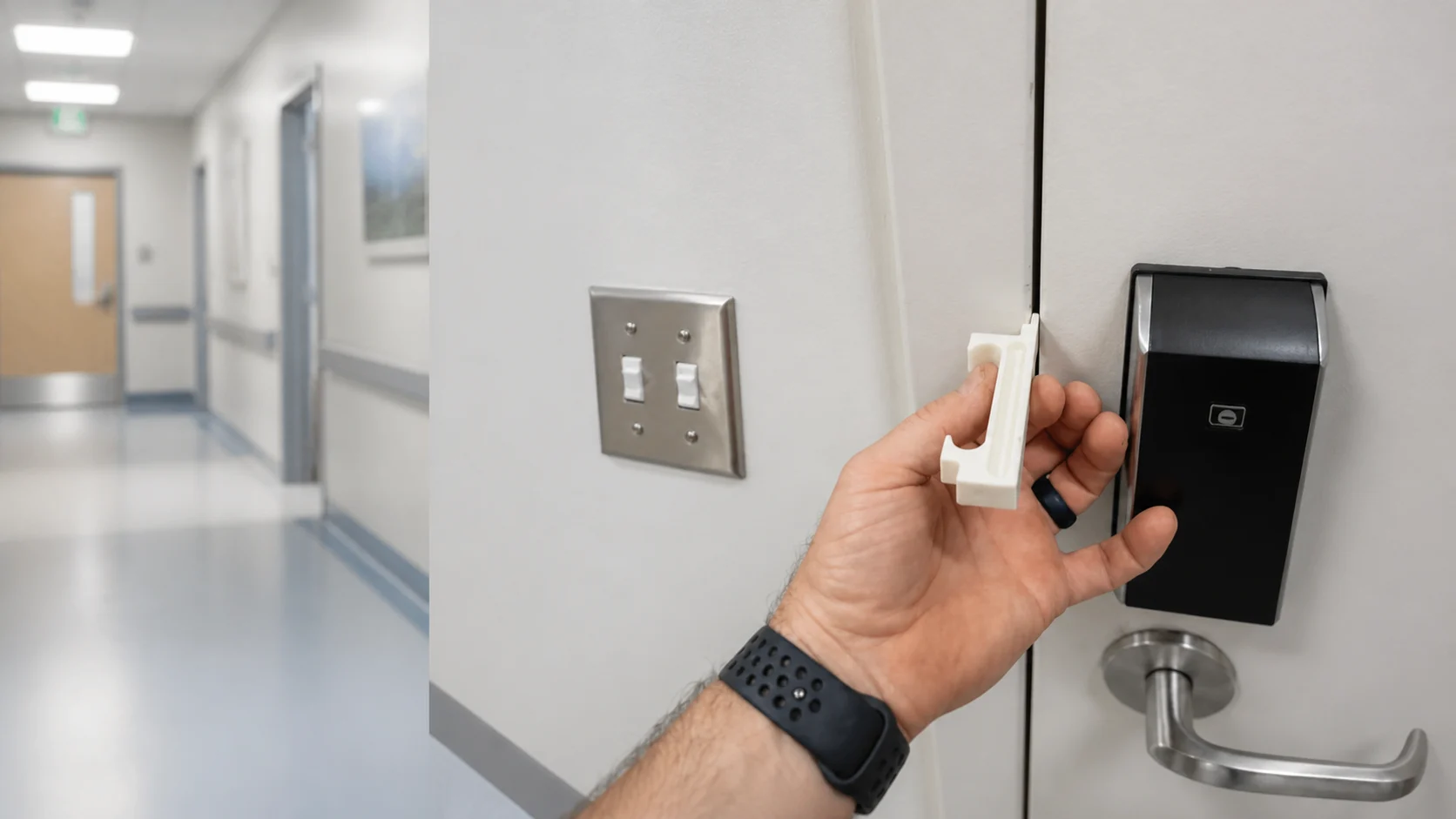
Use the governing edition and assembly type
For CMS-certified healthcare facilities, the federal annual-inspection path points to the 2010 edition of NFPA 80 through the adopted 2012 Life Safety Code. Clearance criteria can vary by door construction, hardware, listing, and newer editions, so confirm the actual governing edition and assembly type before measuring. A generic gap gauge card is useful only when its thresholds match the door being evaluated. Record unresolved listing or construction questions rather than forcing every opening into one tolerance.213
Know the common swinging-door limits
For typical swinging fire doors with builders hardware under the CMS-referenced 2010 NFPA 80 criteria, the clearance at the head, jambs, and meeting edges of pairs is generally limited to one-eighth inch, and the clearance under the bottom of the door is generally limited to three-quarters inch. These familiar numbers are not permission to ignore the listing, threshold, floor covering, special door type, or measurement method. Confirm the complete applicable provision before declaring compliance.125
Measure consistently at the installed opening
Use a suitable feeler gauge, tapered gauge, or other appropriate tool with the door closed and the leaves in their normal position. Measure at multiple points along both jambs, across the head, at meeting edges, and along the bottom. Note bevels, warpage, thresholds, uneven floors, and pairs that change position when latched. Record actual measurements and exact locations for failures. A single photograph or one measurement at the most convenient corner cannot establish the condition of the full perimeter.167
Diagnose hinge, frame, and floor movement
Excessive or uneven gaps often result from worn bearings, loose fasteners, incorrect hinge size, bent hinges, frame spread, anchor movement, door sag, building movement, or changed floor finishes. A bottom gap can become noncompliant after flooring is removed; a formerly acceptable head gap can tighten when new flooring raises the leaf. Diagnose the cause before selecting a shim, hinge adjustment, edge treatment, or replacement. The repair must restore the listed assembly without creating binding, misalignment, or latching failure.145
Look beyond the gap number
Clearance is one inspection criterion within a functioning assembly. A door can meet the numerical gap and still fail because it does not close, latch, sequence, or release, or because labels, glazing, hardware, or surfaces are deficient. Conversely, an excessive gap should not be disguised with unapproved gasketing or filler. Inspectors should evaluate the relationship among clearances, latch engagement, coordinator operation, astragals, seals, air pressure, and floor conditions so correction addresses performance rather than only appearance.185
Choose a listed or approved correction
Common corrective paths may include securing or replacing permitted hardware, adjusting hinges and closers, restoring frame anchorage, installing a listed edge product where applicable, or replacing a damaged component. Applicability depends on the door construction, label, listing, manufacturer instructions, and authority acceptance. Do not plane, weld, fill, plate, or build up a rated door or frame based solely on a contractor's usual practice. Obtain listing-agency, manufacturer, field-label, or design-professional direction when the repair exceeds clearly permitted maintenance.197
Retest and trend recurring clearance failures
After correction, remeasure the full perimeter and retest closing, latching, and pair sequencing. Update the inspection record with the final measurements, repair documentation, date, and verifier. Trend openings that repeatedly sag, rub, or exceed gaps because recurrence can reveal frame movement, high-cycle hardware wear, pressure imbalance, abuse, or an unsuitable prior repair. Feed those patterns into preventive maintenance and capital planning so the annual inspection does not rediscover the same assemblies without a durable response.1467
Explore the complete topic
Continue from this article into the connected cornerstone guides, detailed conditions, exact questions, and related services.