
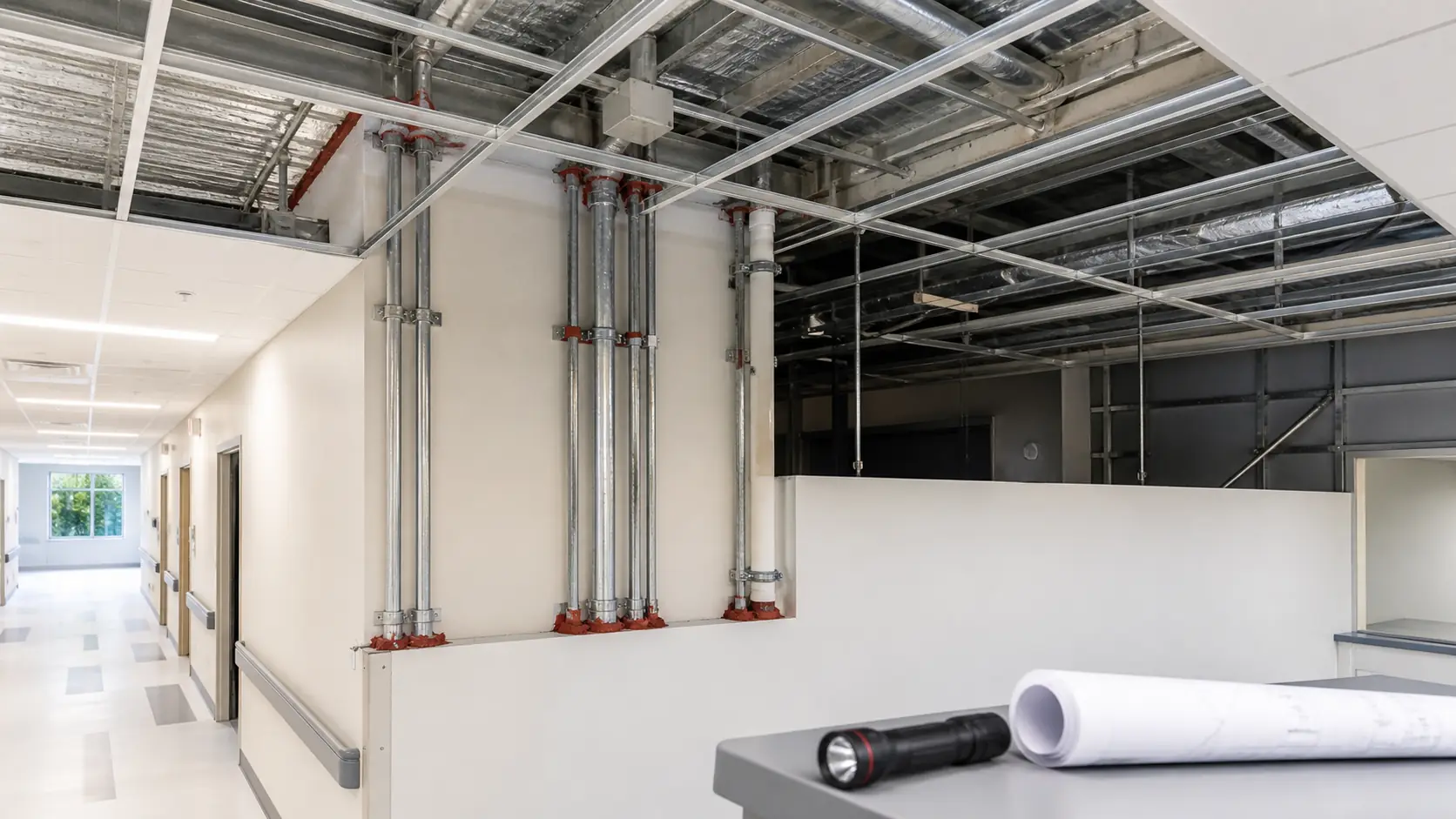
Start with function, not appearance
Walls above ceilings can be fire barriers, smoke barriers, fire partitions, smoke partitions, shaft enclosures, corridor separations, acoustical partitions, security walls, or ordinary construction. Similar gypsum surfaces can have very different requirements. Confirm the approved function using life safety drawings, code analysis, project records, and field context before evaluating continuity or penetrations. A wall that reaches the deck is not automatically rated, and a wall that stops above the ceiling is not automatically deficient without establishing what it is required to do.1234567
Use controlled drawings as a starting point
Current life safety drawings should distinguish barrier types, ratings, endpoints, and openings, but they must be reconciled with the field and approved construction records. Trace the line to intersections, exterior walls, shafts, floors, and concealed transitions. Look for renovations that moved rooms or changed occupancy without updating the plan. If several drawings conflict, record the classification question and obtain qualified resolution. Do not choose the most conservative label simply to make the inspection easier; false ratings create inaccurate inventories and unnecessary work.1234567
Apply rated-barrier criteria only where supported
For a confirmed rated assembly, evaluate construction, continuity, joints, penetrations, opening protectives, ducts, dampers, and interfaces according to the applicable listed or approved design and adopted code. Record the rating and system basis with the finding. A rated-barrier repair must restore the complete assembly, not only cover a visible gap. At transitions between rated and unrated walls, identify the true endpoint so maintenance teams do not extend firestop requirements beyond the approved boundary or miss the protected side.1234567
Recognize smoke-resistance requirements
Some healthcare separations may be required to resist smoke without carrying the same fire-resistance rating as a fire barrier. Openings, joints, doors, ducts, and penetrations still require evaluation under the applicable smoke-control provisions. Do not equate unrated with unrestricted. Conversely, do not cite every cable opening in an ordinary acoustical wall as a Life Safety Code smoke-barrier violation. The inspection record should state the function being protected and the evidence used to determine it.1234567
Separate code deficiencies from maintenance concerns
An opening in an unrated partition may still need attention for infection control, acoustics, security, energy, pest control, or facility standards. Document it under the correct program rather than converting it into a rated-barrier deficiency. Accurate classification helps leadership prioritize real life safety risk and prevents contractors from installing unnecessary firestop products. It also protects credibility during survey activity: presenting a large list of mislabeled fire-barrier failures can obscure genuine gaps that require immediate corrective action.1234567
Create a barrier-identification method
Assign stable barrier identifiers, use consistent line types and field labels where appropriate, and connect the drawing to penetration, damper, door, and permit records. Train inspectors to pause at ambiguous boundaries and use a documented escalation path. During projects, require designers and contractors to identify barrier function in submittals and closeout. Avoid relying only on paint color above the ceiling; colors fade, renovations overlap, and local conventions can change. Field markings should support, not replace, controlled documentation.1234567
Audit classification accuracy before repair campaigns
Before launching a large sealing or barrier-repair project, sample the underlying classifications. Compare drawings, wall construction, approved details, occupancy relationships, and observed endpoints. Reclassify inaccurate records through controlled review and revise dependent inventories. Then scope repairs using the verified barrier population. Track avoided false deficiencies as well as confirmed corrections. The result should be a smaller, more accurate worklist tied to real protection functions rather than a visually driven effort to seal every concealed opening indiscriminately.1234567
Explore the complete topic
Continue from this article into the connected cornerstone guides, detailed conditions, exact questions, and related services.